Saturday, December 3, 2022

The Hidden Enemy


"Ajatashatru" is a very lucky person. The word literally means "a person whose enemy is not born". There are many friendly people around us. Some may claim that they have friends everywhere and they have no enemies. Yudhishtira, one of the Pandavas, was considered an Ajatashatru. It is said that even Duryodhana was well disposed towards Yudhishtira and would not have minded his becoming the King, but for his brother Bheemasena who was Duryodhana's sworn enemy. History tells us that there was a King by name Ajatashatru, son of King Bimbasara, who ruled a large area of our country some 2500 years ago. This Ajatashatru fought many battles and had many enemies as well. He was an Ajatashatru only by name.

Having enemies is thus a reality for most of the people. The number of enemies and intensity of enmity may vary, but enemies would always be there. Once a person knows there is an enemy, identifies the enemy and level of hostility, some remedial action can be taken to protect one's own interests. What happens when there is an enemy lurking behind, but it is not known? The situation indeed turns dangerous.

The above position is true of an external enemy. What happens when the enemy is from within? When someone expected to be our protector turns and betrays us? A close friend or protector turning into an enemy and taking us by total surprise? 

People hire watchmen to protect their houses and properties from outside forces and enemy elements. The one who has hired the watchman feels secure and relaxes in the comfort that the watchman takes care of the attackers or intruders. But we often read in the newspapers and media that the watchman himself has turned hostile and brought tremendous misery to the master. There are instances where watchmen or security guards have turned out to be responsible for various undesirable happenings in the area they are expected to guard and take care of!

*****

The three letter sentence from the play "The Tragedy of Julius Caesar" by William Shakespeare is often quoted when an enemy strikes from within. The date was March 15, 44 BC (nearly 2066 years ago). There is the mention of Ides of March as well. Act 3, Scene1 of the play gives out the details. Julius Caesar is attacked by a group of senators and stabbed to death. At the moment of being stabbed Caesar identifies his associate and friend Marcus Brutus as one of the persons in the conspiracy to stab and kill kill him."'Et tu, Brute" he says and falls. The Latin sentence meaning "Even you, Brutus!" has become immortal and often used to represent betrayal by someone who was expected to protect in the normal course. Decimus was much more trusted by Caesar and was the only one to who could be called close to Caesar. But the reference of betrayal is done to Marcus Brutus as the three words in the play have made history.
*****

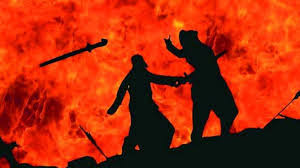
Present generation may not concern with Caesar and Brutus, but they certainly remember Kattappa and Amarendra Bahubali. Kattappa ws a slave and initiated into serving the Royal family of Mahishmati. The internal politics of Mahishmati conspires to utilise Kattappa to kill Amarendra Bahubali. Amarendra is killed by a trusted lieutenant Kattappa, though Kattappa later realises that he was fooled and used as a tool to kill Bahubali. Kattappa was an unwilling element in the big scheme of things, but he did kill Bahubali in the most unexpected circumstances. Kattappa did repent later but the action was irreversible by then.

*****
Mukunda Rao was unable to see things clearly and went for an eye check up. The Optician identified that cataract had developed in both eyes and surgery was required. As the first step in the direction of surgery, the retina of the eyes had to be scanned. He was directed to the optometrist for this purpose. The Optometrist asked Mukunda Rao to place the eye in place on the scanner and open the eye widely for a proper scan. As the scanning was in progress the eye got narrowed and closed. Optometrist tried three times but each time the eye drooped and scanning stopped. The Optometrist got frustrated and harshly told Mukunda Rao to keep the eyes wide open. Mukunda Rao said he wants to keep the eye open but it is getting closed involuntarily. The Optometrist summoned an assistant and made her hold the eye open and finished the scanning!
*****

Scanning was done, date for surgery was fixed and completed successfully. After the post-operative care was completed and the time came for prescription of glasses Mukunda Rao sat again before another Optometrist. As the examination of eyesight was in progress, Mukunda Rao asked the Optometrist which of the two images he should concentrate on. Optometrist was baffled and asked whether he was seeing two images all the time. Mukunda Rao said it happens sometimes and he can see a single image clearly at other times. Optometrist said the vision will stabilise once the spectacles are used regularly. Mukunda Rao paid a heavy amount for the fancy new spectacles and started using it. He was now seeing fancy double images and could not understand how many steps are there on the stairs or whether the footpath was even or uneven. The problem of double vision remained despite cataract surgery and the new fancy spectacles. Mukunda Rao now knew a new word - Diplopia. Diplopia is the name for double vision.

*****

Vamana Murthy attended all social and religious functions in his circle. He was often called upon by his friends and relatives to speak to the gatherings on such occasions. Being a teacher and trainer, he was comfortable in such roles and could speak extempore and keep the gatherings occupied during such events. He was also invited as a speaker or chief guest at many functions. Of late he started feeling that the spoken words were not clear sometimes and the speeches were slurred on occasions. This was more pronounced towards the evenings. Vamana Murthy now started to avoid attending the social and cultural gatherings.

*****
Madhusudana Rao took fancy to the new generation of smart watches and purchased a premium model that recorded various daily activities. The watch spurred him into longer walks in the morning at the friendly neighbourhood park. The statistics on walking show that the average number of steps taken by people allover the world is about 5000 in a day. Madhusudana Rao started with this goal and progressively increased the daily limit. He crossed 15000 steps on most of the days and took pride in his achieving daily goals. He observed that things were not the same of late and he got exhausted and felt shortness of breath even with small walks. Walking that was such a pleasure now became a tedious exercise.
*****

Narendra Rao was fond of savouries with a liberal spread of cashew nuts, almonds and groundnuts. A small quantity of mixture would accompany the evening cup of tea or coffee. All the teeth were in good shape and chewing these items leisurely and enjoying with coffee or tea was a pleasure especially on weekend afternoons. Things changed suddenly and Narendra found it difficult to crush and chew the almonds in his jaws. Groundnuts were alright, but harder nuts like almonds were a different nut to crack. He slowly started to remove the almonds and throw them away when other members of the family were looking elsewhere. Swallowing the chewed food also became difficult in due course. When he tried to push the liquids through the gullet, instead of going through the throat the liquid came out through the nose! Quantity of food consumed came down drastically and weakness in the muscles set in slowly. Swallowing the daily dose of tablets also became a big task.
*****
Kumaran was very active and would get ready to go to office or outdoor visits in a jiffy. The process started taking more time now. Buttoning the shirt sleeves needed more efforts. Picking things kept in the higher shelves also started posing problems. Spreading cloth for drying and similar chores took more effort now. Hours spent in sound sleep got reduced and there was a general dullness in the routine. Breathing became a strenuous exercise and would disrupt the sleeping pattern.  
*****

With the increase of awareness about physical fitness and health care, one would normally run to a doctor when confronted with the above problems. These symptoms are generally treated as originating from stroke or ENT issues. Ophthalmologists are expected to identify this promptly, but that is not always the case. Treatment for cataract is often confused for setting right double vision which is not true.

Myasthenia Gravis (MG) is a disorder that worsens after periods of activity and improves with rest. The symptoms mentioned above are worse as the day progresses and the persons dealing with these are better off in the mornings. But the situation would aggravate if not diagnosed early and remedial action initiated.  

MG is an autoimmune disorder, in which the immune system of the body that is expected to protect the body from outside organisms mistakenly attack the body itself. This is similar to the situation where the watchman attacks the master. Myasthenia Gravis is caused by an error in the transmission of nerve impulses to the muscles. It is said to occur when normal communication between the nerve and muscle is interrupted at the neuromuscular junction, where nerve cells connect with muscles they control. Technical details are  available on the internet and medical journals.

The typical symptoms of MG are:
  • Drooping f the muscles of one or both eyes.
  • Double vision or Diplopia.
  • Impaired speech, especially towards evenings.
  • Difficulty in chewing and swallowing.
  • Shortness of breath even in cases of short walks or physical activity.
  • Difficulty in breathing and shortness of sleep.
  • Weakness in hands, legs, fingers and neck muscles.
Myasthenia Gravis cases are rather rare and only some 15 to 20 cases per million population are said to carry this disorder. It is not contagious and does not run in the family. It can happen at any age group or gender. Though the disorder is itself rare, extensive research is done on this and advanced treatment is available.But unfortunately many cases go undetected and patients suffer silently and lead to what is known as Myasthenia Crisis.

When the muscles that control breathing weaken Myasthenia Crisis develops and the person requires ventilator support to breathe. Infections, stress or surgeries may trigger this crisis. Care must be taken to prevent slipping into such crisis.

Despite the issues relating to MG, people can lead a normal life by suitably changing life style and proper medical care. There are many prominent personalities with MG disorder and yet managing successful lives and leading in their respective fields.
*****

Anyone suffering from the symptoms mentioned above would do well to take a precautionary test after getting suitable medical advice.

The hidden enemy can be managed and controlled once identified!

Wednesday, October 26, 2022

Our Lifelines - The Rivers


A news item 
dated 2nd November, 2021 in Bangalore Mirror screamed - "No amount of rain can put life in Arkavathy river". It made a sad reading for many of us who were born and brought up on the banks of this river. Arkavathy has been a part of our innumerable childhood memories. Having been an integral part of our lives in the formative years, this river water was the taking care of the needs of the residents of all villages and towns along its banks as well as of Bangalore City, till 1974. The reservoirs at Hesaraghatta and Tippagondana Halli were the main water supply sources to the city.  Hesaraghatta reservoir was constructed in the year 1894, as a first source of drinking water to Bangalore. As the city grew and population increased, another reservoir at Tippagondana Halli was constructed in the year 1933. Illustrious names like K Seshadri Iyer and Sir M Vishveshvarayya are associated with the constructions of these two reservoirs.  As the demand for water increased due to further growth of the city, waters of the Cauvery river were brought in from about 60 miles, near Tore Kadanahalli, in the year 1974. We have now reached a stage where even this arrangement is not sufficient to meet the growing needs of the mega city.

The many "Neelanji" trees on the banks of the Arkavathy river, with their many roots playing in the river waters, provided a wonderful setting for river waters users. There was regular flowing water in the river during rainy seasons. There was some source of water below the sands of the river bed throughout the other months of the year. Urbanisation and excavation of sand from the river bed for decades for roads and other building constructions sadly removed this source. The headline in the newspaper did indeed burn our hearts. 

As if to prove that the river can be brought back to life, the copious rains in Bangalore and surrounding areas in the first week of August 2022 created heavy floods in the river Arkavathy! The floods have been compared to the flood in 1962, sixty years ago when we were in schools and visited the flowing river in our town. Though many rivers have been destroyed due to mindless urbanisation, it is not late even now to remedy the situation, this floods in Arkavathy show.

Recordings of the details of Bangalore's surroundings detail that there were over 300 lakes served by this river, starting from its birth place in Nandi Hills until it merged with river Cauvery just before the famous "Mekedaatu". All these lakes have been mercilessly encroached over the years and land sharks have converted them to residential colonies. A cabinet minister of Karnataka is on record of having said in the state assembly that the administration was forced to fill all the lakes to solve the problem of breeding of mosquitoes! Everyone knows the real reasons for filling up these lakes. The innumerable housing and commercial complexes that have come up on these tank beds are a living testimony for the actions of real estate developers. Whenever there are heavy rains in the area there is regular flooding of water in the houses and buildings in these encroached areas. 

*****

Rivers have been the arteries and veins of all life on the planet Earth. With their many uses to support all forms of life, rivers have been cradles of civilisations all round the globe. Water is available in many sources on earth; oceans, lakes, wells etc. Rivers provide flowing water and when not polluted, provide fresh potable water at all times. Modren way of life has brought in many dangers to the rivers and their existence. The froth-laden waters of Yamuna flowing near Delhi and Agra is a burning example of our callousness towards rivers.

We in India often remember river Saraswati as one of the sacred rivers. It is believed as a mythical river now. There are many theories about this river. Some claim that the river was flowing in westren India, comprising the present westren parts of India, present day Pakistan and Afghanistan. There are also theories that the river flowed and merged with Ganga and Yamuna in Prayagraj (Allahabad) forming a "Triveni" Sangam. There are a group of people known as "Saraswat" who are believed to have originated from the banks of these river, but now spread over various parts of the country, more so in Maharashtra, Goa and Gujarat. We have not seen this river in our life time. But her name is chanted on a daily basis by many Shraddalu people allover the country.

We have never seen river Saraswati flowing during our life time, yet there are many rivers we saw in our life time, but are now only existing by name and with no water flowing in them during most parts of the year. Cutting down forests and converting them into other purposes have dried up their origin sources which fed water to them. These rivers were well and truly alive when we were children and we have fond memories of having lived by their sides and played in their waters. We have also seen floods in them almost every year. But by the time of our children and grand children, they are existing only in name. Names of some of these rivers are also being forgotten now. This is the price we are paying for unplanned growth and greedy needs of our civilisation.

*****

A journey from Bangalore to Delhi by train would take two full days in the 1960s. Travelling by air was not an option in those days for most of the people. The 48-hour journey was itself enjoyable and provided an opportunity to cross many rivers on the way. Youngsters would sit on the window seats and wait to see these rivers. The blue waters in some of the big rivers was a treat to watch, especially in the hot summer months. Throwing coins in some of the rivers considered sacred was also seen. Crossing Krishna, Godavari and Narmada rivers was indeed memorable.

Even a small trip of 90 miles (140 KM) from Bangalore to Mysore by train or bus would give a glimpse of a number of rivers on the way. There was Vrushabhavati as soon as one left Bangalore and gave company for some six miles, flowing by the road side. Arkavathy would show up in Ramanagaram, followed by Kanva river after Channapatna. Shimsha would show up just before Maddur. Lokapavani before Srirangapatna heralded East Cauvery and Paschima Vahini, the two branches of Cauvery. As railway locomotives were steam engines, Ramanagaram, Maddur and Srirangapatna were known as water stations. It was a thrilling sight for children to see water being filled into the engines in these stations. As Maddur was near the mid point, the water filling time was also providing an opportunity to the passengers to enjoy the famous "Maddur Vada"

There are many tourist spots along these rivers. Ranganathittu Bird Sanctuary is one of the major tourist attractions in the area. Many film scenes have been shot in the surroundings of this bird sanctuary. One of the popular films "Paakeeza" has riverside and boat scenes shot in this area. The immortal song "Chalo dildar chalo, Chaand ke paar chalo" is filmed in the area between Ranganatittu and GaganaChukki and BharaChukki water falls.

Kanva Resorvoir is a water storage dam constructed on the Kanva river and situate about 8 miles away from the town of Channapatna on the Bangalore - Mysore Highway. It is a scenic spot and popular among the youngsters for picnic and hiking activities. 

*****

When we think of the rivers we see on the way from Bangalore to Mysore, we also recall the famous temples along the road. Among the many temples are Ramadevara Betta near Ramanagaram, Ambegalu Krishna just outside Channapatna in Maluru, Ugra Narasimha and Varadaraja in Maddur and Sri Ranganatha in Srirangapatna.

The Ambegalu Krishna or Aprameya Swamy in Maluru on the banks of Kanva river, just outside Channapatna is a popular stop for many travellers between Bangalore and Mysore. Legend has it that the king ruling this area married a young girl at his old age. Kings were known to have many wives and many of these marriages were a result of political alignments. When a war is lost, the losing kings often offered their daughters in marriage to the winning kings. This king had a young and handsome son from an earlier marriage and he was expected to succeed the throne. The king's young wife took interest in this young prince and desired to develop relationship with him. The young man refused and advised her that their relation is of mother and son and they should stick to it.

The slighted stepmother went to the king and complained about the prince that he was behaving badly with her. The king ordered that the prince's legs be cut off and and he be thrown into the Kanva river. The orders were carried out. The elderly minister approached Sri Brahmanya Tirtha, a sage in the nearby village Abbur, situate on the other bank of the river, to remedy the situation. It is believed that Sri Brahmanya Tirtha gave holy Mrittika (mud) and advised that it be applied on the wounds. In due course the prince's legs started growing and he became normal. The temple got the name Maluru, meaning the germinating process in the local language.

Of course, there are many other versions of the story about the temple and how the place got the name Maluru. The idol of Krishna with a bowl of butter in his hand is beautiful. It is believed that Sri Purandaradasa composed the song "Aadisidaleshoda jagadoddharana" at this temple. The festivities at the temple reach the peak during Krishna Jayanti celebrations. Many people from nearby areas converge to worship at the temple during these days.

Friday, May 21, 2021

I Am Not Yet Ready


What is the difference between human beings and animals? Can the difference be defined with a most notable single feature? It is the capacity to think, understand and relate. The human brain works at different levels at the same time. It takes in multiple inputs, sorts and understands them, store and retrieve the required parts as and when desired. There is also the capacity to transfer these stored and accumulated information and knowledge. Some animals also display such qualities but they are to a very limited extent. Dogs and Parrots are the best examples. Other animals are also trained to do certain actions and used in shows and circus. Some of them like Elephants are used to work as well so that the life of humans is simplified and made easy. But all these meet with limited success. This basic distinction also results in the capacity of human beings being able to visualise things, plan their execution and act decisively to achieve those plans. This makes human life interesting as well as complicated! 

Human beings visualise, plan and execute those plans. This requires action or a series of actions. As a human being is executing many plans simultaneously, there are multiple sets of actions in implementation at any point in time. In case of team tasks, there are multiple sets of actions being implemented by each member of the team to achieve the common goal. 

What are the basic objectives behind all these actions? This is a very interesting question. One of our well known ancient philosophers Kumarila Bhatta has quoted from Parashara Samhita (Verse 59 of 13th Chapter) that even a stupid person will not venture into something without evaluating its utility  (प्रयोजनमनुद्दिश्य न मन्दोपि प्रवर्तते - Prayojanamanuddishya na mandopi pravartate). His evaluation may be defective, but it is another matter. This being the case why does a person act in a given direction?

Each action has two basic objectives; to get rid of some difficulty or sorrow and achieve some pleasure (दुःख निवृत्ति, आनंद प्राप्ति). Thus many actions lead to a second situation (action) to rid of an existing situation. The funniest part is that each pleasure so derived often brings its own pain either immediately or with a time lag. This leads to a further action and so on....

The above chain is very well chronicled in the birth of Draupadi in Mahabharata. 

***** 

Sage Bharadwaja is one of the Saptarshis, the seven revered sages, and is credited with immense contributions to our Vedic literature, Ayurveda and many other branches of learning. He is the son of Devaguru Brihaspati and devoted his entire life to learning and teaching. He had taken a vow of celibacy and remained a bachelor. One morning he was going to the river near his hermitage to take bath and start his daily routine. Ghrutachi, a celestial nymph (apsara) had just finished her bath in the river and came up. A strong wind blew away the thin cloth she was covering herself with. She recovered her cloth and went away. Rishi Bharadwaja saw her and for a moment his mind was severely disturbed. Surprised at the happening, but satisfied that this was due to some cosmic will of the Lord, he collected the semen in a vessel made of leaves. In due course of time, a handsome boy came out from the pot. The boy was named as Drona, as he was born not from a mother's womb but a Drona, a container made from leaves. 

Sage Bharadwaja brought up the boy by giving him proper education. The prince of Panchala kingdom, Drupada, joined the gurukul of Bharadwaja. Drona and Drupada became close friends. Drupada once promised that when he becomes the king of Panchala, Drona can have anything he wants, even half of his kingdom. In due course, Drona came to be known as Dronacharya and was appointed by Bhishma as the Chancellor of the Archery and Weapons Training School in Hastinapur. Drupada became the king of Panchala. Dronacharya married Krupi,  the sister of Krupacharya, Guru of the Hastinapur kings. The son of Dronacharya and Krupi was named as Ashwatthama, who later became an important General in the army of the Kauravas.

Dronacharya was leading a contented life with Krupi before coming to Hastinapur, without asking any favours from anyone else. Young Ashwatthama was being given rice flour mixed in water as milk. After becoming friend with Duryodhana, once he had a chance to drink the real milk in the palace. Ashwatthama demanded that he be given real milk henceforth. Krupi persuaded Dronacharya to approach his childhood friend Drupada, who had now become a king, for getting a cow so that Ashwatthama can be given proper milk. Though unwilling, Dronacharya went to king Drupada. Drupada laughed at his friend and said there cannot be any friendship between a king and a pauper. Enraged at this behaviour of Drupada, Dronacharya took a vow that he would have Drupada captured by his disciples to teach him a lesson. A new set of actions were set in motion now.

At the convocation of the Archery and Weapon School in Hastinapur, the issue of giving "Guru Dakshina" (a fee by the student to his teacher) came up. Dronacharya used the opportunity and told kauravas and pandavas that he would like them to defeat Drupada, capture and present him at Guru's feet. Kauravas went first but were defeated by Drupada and his army. Pandavas went in next and Arjuna succeeded in in defeating and capturing Drupada. Dronacharya pardoned Drupada and sent him away saying that he is now gifting away the entire panchala kingdom to Drupada.

Now it was the turn of Drupada to feel insulted. He was extremely impressed by the bravery and skills of Arjuna. He now decided that he would do something to get a son who would kill Dronacharya to get his revenge. He will also get a daughter so that he can make Arjuna his son-in-law. The twin desires now put a further set of actions in motion!

*****

The task was not an easy one. There must be some method to achieve these twin objectives, Drupada thought. He entrusted the kingdom to his ministers and set forth in search of someone who could guide him to achieve his goals. He went to the forest and found a Rishi who appeared competent to guide him. The rishi was Upayaja, a brother of rishi Yaja (Similar to Indra and Upendra, Upa meaning younger brother). After hearing Drupada's request, Upayaja refused and said that he is not willing to get involved. On repeated requests by Drupada, Upayaja said that he can approach his elder brother Yaja who may accept his request. After serving Yaja for a long time, he agreed to do a holy ritual (Yagna) to achieve the objectives. But Yaja put a condition; it was not possible for him to do it alone and his brother Upayaja should join him in the conduct of the ritual! Drupada was now again forced to go to Upayaja. Upayaja agreed to assist Yaja as it was a command of his elder brother. The two brothers made all arrangements and started the ritual.

The time was set for the ritual. Drupada and his wife Queen Prishati started the proceedings. After the initial phase, Prishati was permitted to attend to the guests and arrangements at the site and advised to be available as and when called to take further part in the ritual. At the conclusion of the ritual, a divine messenger appeared from the fire and handed over the "Yagna Phala" to Chief of the ritual, Rishi Yaja. Yaja advised Drupada to call his queen Prishati to join him to receive the Yagna Phala. When the queen was called to the site of the sacred fire, she said "I Am Not Yet Ready" to receive the Phala as she was busy with some chore and had perfume in her hands. Enraged at this Rishi Yaga shouted and said that the divine events do not care whether anyone is ready to respond to them. He said that a ritual done under the leadership of Yaja and Upayaja cannot go waste nor can it wait for someone to come. He put back the yagna phala back into the sacred fire with a prayer.

As a consequence of this, a remarkable boy of about 14 years in shining armour emerged from the fire. Following him, a very beautiful girl with dark complexion emerged from the fire. The boy was named Drishtadyumna and the girl was named as Krishnaa due to her complexion. She was later known as Draupadi, the daughter of Drupada. The one born without a mother's womb (Dronacharya) was now destined to be killed by another born without a mother's womb (Drishtadyumna). Another set of actions were set in motion now.

Queen Prishati was now crestfallen. She had looked forward to be a proud mother of divine children, but now was deprived of this distinction. She was also worried as to how the two children would deal with her now that the bond a mother had with her children she delivered is absent. She requested Yaja and Upayaja to bless her. The two brothers recognised her position and gave her a boon. "The two children will treat you as if you have given birth to them. You will enjoy all the blessings and happiness a mother can expect from her children. Shower your love and affection on them as well", they blessed her. Thus ended the saga of the sacred ritual, but it was only sowing the seeds of the future actions.

*****

In all such sacred rituals, Yagna Phala results in the couple getting children delivered by the mother, but this was an exception when the children emerged from the sacred fire itself. It is a very interesting and intriguing story. 

Is there a lesson in this for us? Revenge opens the gates for another revenge, is the first one. Forgiving and starting a new chapter in one's life is more beneficial than keeping old wounds open and seeking to settle scores with our friends who may sometimes offend us. Understanding that elders and events do not wait for us and we should be ever ready, is the second. The main objective should not be forgotten while looking into allied things, one should remember. If and when something adverse happens, one should try to retrieve and salvage whatever best is possible, as done by Queen Prishati, is the third.

Do you find any other lesson as well?

Saturday, May 8, 2021

Please Wait For Your Turn....


The mighty milky ocean was churned for a long time. Devas and Asuras joined together in this task, despite their irreconcilable differences, with the only hope of getting the "Amruta" the Nectar, consuming which would make them immortal. There were many problems and difficulties on the way, but ultimately Lord Dhanwantari emerged with the pot of Nectar. One of the Asuras stole the pot and ran away with the intention of denying the Devas of their share. Lord Mahavishnu appeared as Mohini. Just by looking at her, the one who ran away with the pot dutifully handed it over to her and everyone requested her to equitably distribute Nectar to all.

Mohini made all the Devas and Asuras sit in separate lines and distributed the Nectar. Mesmerised by her beauty, the Asuras did not even complain when distribution started on the other line. Ultimately they were denied any share of Nectar. The present day practice of our political leaders distributing the benefits of government schemes to their party-men only, has its origin here and we should not unnecessarily blame them. Asuras fought with Devas but lost the war since the Devas had now become immortal due to the effect of the Amruta consumed by them. Many Asuras were killed and they had to ultimately run away to the lower worlds. 

The Asuras did not have the Nectar, but their Guru Shukracharya had the power of "Mrutasanjeevani" with him. He restored all his disciples to the original forms. Devas came to know of this. Now they wanted to divest Shukracharya the power of this Mrutasanjeevani. Kacha, son of Devaguru Bruhaspati was deputed to the hermit of Shukracharya for this secret mission. Kacha served Shukracharya for a long time but Shukracharya did not part with the secret as he was aware of the dangers of kacha's mission. Asuras came to know of the efforts of Kacha. When Kacha went to the forest on some errands, they cut him to pieces and fed the parts of his body to wild foxes so that he will not be alive and succeed in his mission. 

Devyani, daughter of Shukracharya was fond of Kacha. She cried with her father when kacha did not return from the forest in the evening. In order to pacify her, Shukracharya used the Mrutasanjeevani process to bring back Kacha to life. The parts of Kacha's body tore open the stomach of the foxes, assembled together and came back as kacha. Such was the power Mrutasanjeevani had!

The Asuras were unhappy that Kacha has come back to life. They wanted to create a situation where Kacha would never come back to life. This time they cut Kacha into pieces, burned the pieces, mixed the resultant ashes in wine and served the same to Shukracharya himself. When Devyani again cried with her father, he said nothing can be done. But Devyani was not one to give up and she insisted that her father can somehow find a method to resolve the issue. Unable to deny his daughter, Shukracharya used the powers of Mrutasanjeevani to bring back kacha to life inside his stomach. Once he became alive, Shukracharya taught him the knowledge of Mrutasanjeevani while in his stomach. Kacha burst out of Shukracharya's stomach but Shukracharya was now dead. Kacha used the knowledge of Mrutasanjeevani to restore Shukracharya to life. Once his mission was completed, Kacha went back to the upper worlds.

*****

Banking practices were much different forty or fifty years ago. There were no computers and all records were maintained manually. Physical control of records and securities at the branch was very important. Branch Manager was the most important person and held many such records and assets in his custody. When a Branch Manager was transferred and a new person posted in his place, there was a need to physically hand over certain records and assets, including the pledged securities held in the branch safes and pledged godowns of loan customers. In order to facilitate this process, there was a procedure of handing over charge of the branch by the existing Manager and taking over of charge by the new person. Depending on the size of branch and business levels, a period of one or two weeks were allowed for this process. The incoming Manager was provided temporary accommodation in a hotel, he would report at the designated branch and start the process and proceed systematically taking custody of the records and assets. On the final day, a charge taking over report was prepared and signed by both the persons and the process would be complete. The earlier Manager would proceed to his next branch to set the same process in motion there.

During this one or two weeks period, known as Charge Taking Period, the earlier Branch Manager would continue to sit in the Manager's chair in the cabin. The incoming Manager would sit in one of the chairs opposite to him (usually meant for customers). All actions of a BM were done by the outgoing Manager till the day charge taking was complete. The process was usually smooth and the new Manager occupied the Manager's chair only after the previous incumbent handed over charge and left. The principle followed was that there is only one BM in any branch on any given day.

With the advent of computerisation and change in the method of managing things, this process is no longer followed. Time spent on charging making over and taking over and the expenditure thereon is now considered a waste. In today's banking, things manage themselves and nobody really has any control over the affairs of a branch! The illusion that things are under control make everyone happy and the world goes on...

*****

The vaccination against Covid pandemic had just started in the first week of April. Front line workers like Doctors, Nurses and other medical staff were vaccinated in the previous two months. When the vaccination opened up for the general public, persons with age of over 60 years were allowed first to get vaccinated. All these were senior citizen and the anxiety and initial teething problems in managing such a huge effort was telling on them. The large crowds at the hospitals, the process of producing and checking documents, the struggle of the dealing staff in handling the process, slowness of the computer systems in bearing the burden, handling vaccination while attending to other regular patients, all contributed to the delays. A person seeking vaccination had to stand in many Queue; starting with registration at hospital, verification of documents, checking of temperature, BP and Pulse rates, final registration and checks, vaccination proper, observation hall and so on. It was a testing time for all concerned with the added problems of masking and social distancing. 

As it happens in such situations, a new vaccination candidate landed at one such spots. There were many queues around the place and there was total confusion. The elderly gentleman (all were elderly there; the difference was only elderly, very elderly and very very elderly) stood in a queue but after sometime wanted to find out whether he was really in the right queue. He moved out of the queue and went up to the person handling the computer on the other side to make his inquiry. Others who were impatiently waiting for their turn pounced on this gentleman, in not a gentle way. "Please wait for your turn Mister! Don't jump the queue. We are waiting here since a long time", one of them shouted. Some others supported him. One or two supported the gentleman attempting to make the enquiry. Tempers ran high till a smiling hospital supervisor intervened and restored sanity.

Jumping the queue is not tolerated. One has to wait for his turn, even if otherwise eligible tor attention or the place. The rights of those ahead of you are to be respected.

*****

Guru Shukracharya was not happy with the turn of events and the defeat of his disciples. He took the Asura King Mahabali under his wings and made him perform a series of Yagnas (holy rituals) that would bestow on him the eligibility to become the Lord of all the worlds and occupy the seat of Indra, the Captain of the Devas. King Bali was the grandson of Prahlada and son of Virochana. He dutifully followed all the instructions of Guru Shukracharya. Guru Shukracharya gave him additional powers using his own special efforts. 

Armed with his new found eligibility and special powers, King Bali went to the upper worlds to challenge Indra and takeover the seat of the Lord of the upper worlds. Indra looked to Guru Brihaspati helplessly. Guru Bruhaspati told him that the times are in favour of King Bali right now and he is invincible. There is no use in fighting him now and it is advisable to handover the throne and live in exile for sometime. Lord Mahavishnu will intervene later on and resolve the issues involved, Indra was advised. Indra dutifully followed the advise of his guru. Bali took over the reins now.
*****

I was working as an Officer in one of the branches of the bank in the late 70s. There was a Branch Manager, an Assistant Manager and other staff members. Somehow there was a misunderstanding between the Branch Manager and Assistant Manager. They were not talking to each other and roundabout communication was being used. A cold war was going on and I was the mute observer. The Assistant Manager was transferred to another branch after sometime, a new Assistant Manager joined and things were normal.

Days passed and after a year or so the former Assistant manager was promoted and now posted to our branch as Branch Manager. He was to come to his old branch and take charge from his former Manager. He was not in a mood to sit before the other person for a week and go on with charge taking. He arrived on a Monday morning much before the existing manager arrived and occupied the Branch Manager's cabin and seat. Existing manager arrived a few minutes later and found his cabin already occupied by the new BM. He did not want to sit opposite to a man who was much junior to him but now in the same rank. He came and occupied a chair opposite to me. The new BM told me that he is waiving the charge taking, assuming charge on "as it is where it is basis" and the old BM can be relieved anytime he wants. Anyway, he was well familiar of the affairs of the branch having worked there only a few moths earlier.

The charge taking was curtailed to one day and the awkward time thus passed when the former BM left the branch.
****

After King Bali occupied Indra's throne and the Devas were forced into exile, it was the turn of Aditi Devi to be unhappy. Her mighty children were now refugees elsewhere and were denied their rightful positions because of the usurper. She pleaded with her husband Sage Kashyapa to initiate some action and restore the status of her sons. Sage kashyapa advised her to embark on "Payovrata", to please Lord Mahavishnu. During the first half of the month of Phalguna, last month of the Lunar year, prayers were to be offered continuously and shunning all food items. Only a small quantity of milk offered to the Lord was to be consumed as prasada, to sustain oneself. Aditi did this dutifully and Lord Mahavishnu appeared before her.

When Aditi made her intentions known, the Lord informed her that he would certainly take steps to meet her request. He advised her that he would himself take birth as her son. Since Bali was in the ascendant now, it would not be possible to displace him with power. So, the Lord assured her that he will meet her request even by taking the form of a yaachaka (one who is asking for something - beggar would be a crude word for it) before King Bali. Thus was born Vamana, also known as Upendra (younger brother of Indra and hence Upendra). 

After his Upanayana (sacred thread ceremony), Vamana proceeded to the place where King Bali had embarked on another holy ritual (Yagna). All the persons gathered at the site of the ritual were astounded by the presence of the young Vamana. King Bali received Vamana with full respects and asked him what can he offer to the young Vatu. Vamana merely asked for three measures of land for carrying out his daily rituals; the three measures by his own small feet. King Bali was warned by Guru Shukracharya not to be fooled by little Vamana; this was no ordinary Yaachaka. King Bali said he would abide by his promise come what may. He advised the boy that he should ask proper things and not insult the King by asking for three feet of land. He would give him immense wealth as anyone who got something from King Bali would not be required to ask anyone for anything for the rest of his life. On the other hand, he would himself be able to donate to others!

Vaman stuck to his request and said he did not want anything more than three feet of land. Bali reluctantly gave away the land following the prescribed procedure. The moment the transfer of land was done, Vamana (dwarf) started growing and attained the form of Trivikrama, the Giant. All the upper worlds were measured in one step and all the lower worlds in the second step. Now King Bali did not have anything else to give! When asked for the third step of land, King Bali offered the top of his head. Vamana put his foot on King Bali's head and pushed him to the Sutala Loka, one of the lower worlds. Lord Indra was back at the helm of affairs at his usual position. Normalcy was restored.

Prahlada came running and thanked the Lord for the kindness bestowed on his grandson. Where is the kindness, someone may ask. Lord Mahavishnu took one form form of Narasimha for the sake of Prahlada. But for the grandson Bali, he assumed two forms; Vamana and Trivikrama. King Bali's wife Vindhyavali requested the Lord to forgive her husband. What was the offense? King Bali said he would give something. That was the big mistake. How can he give something to Lord Mahavishnu, who is the owner of everything? Ishavasyam Idam Sarvam. Everything belongs to the Lord and others are only trustees of the concerned assets for the time being. The mere thought that i can give something to the Lord who owns everything is itself a serious lapse. You cannot donate something to its owner!

Vamana smiled and assured Vindhyavali that not only King Bali was excused, he is also conferred orders to be Lord Indra in the next Manvantara. Lord Mahavishnu will himself stand as a guard at the royal gate of King Bali's palace in the Sutala Loka, in recognition of the noble qualities of Bali.

*****

There are many interpretations that Lord Mahavishnu did injustice to King Bali. In the SrimadBhagavata, King Pareekshit asks the same question. Why innocent Bali was punished? The answer lies in the two lessons the episode of Bali and Vamana teach us. Mere eligibility does not entitle someone to usurp the seat of another and one should not jump the queue. One should wait for his turn patiently. A competent authority should issue an order for occupying any position. Secondly, everything belongs to the Lord. We are only trustees of a tiny part of his treasure that is entrusted to us from time to time. The arrogance that "I give something" is not acceptable.

How can it be said that King Bali jumped the Queue? What is the measure of time? 

The answer is here:

When measured by the length of our one year, the Yuga Cycle is as follows:

Kruta Yuga:       17,28,000  years
Treta Yuga;        12,96,000 years
Dwapara Yuga:    8,64,000 years
Kali Yuga:             4,32,000 years

(We are in 28th Kali Yuga, First Quarter - Prathama Paada))

One Maha Yuga: 43,20,000 years (one cycle of the above). 

A cycle of 71 Mahayugas (30,67,20,000 years in our measurement) is the span of one Manvantara. So far, in the present cycle, six Manvantara have lapsed; Swayambhuva, Swarochisha, Uttama, Taapasa, Raivata and Chakshusha. 

Present Indra has his reign in the seventh, Vaivasvata Manvantara. 

King Bali will get his chance in the next Manvantara, the eighth - Saavarni Manvantara.

It is also humbling to note that 14 Manvantara is one day for Chaturmukha Brahma. This is one Kalpa. Present Kalpa is Swetavaraha Kalpa. Another 14 Manvantara is one night for him. 28 Manvantara is one full day for him. His span is 100 years measured by such days! Present Chaturmukha Brahma is in his 51st Year. (Dwiteeya Parardha)

*****

When someone like King Bali has to wait his turn and should not jump the Queue, what about about us, who are insignificant in this vast measurement of time? 

We should learn to be patient and wait for our turns!

Saturday, February 27, 2021

When "Six Eyes" Failed Together


The young Probationary Officer (PO) had just started working in the bank, after successful completion of his long training program. He was finally out of a rigorous training schedule and felt relieved that he is no longer dependent on others for his life's needs. He was now secure in his job and the monthly pay packet will take care of his financial requirements. Time had finally come to enjoy the pleasures of life, he thought. The first salary received was only for part of a month as he joined the branch on first posting in the middle of the month. The second salary was better as it was for a full month. A regular monthly credit in his account now onwards will be a routine thing. There will be increments awarded every year. There would be some salary increase once in five or six years as well. If he is able to secure a promotion, the emoluments will go up further. The very thought of these coming events was indeed thrilling.

The Branch Manager called him to his cabin in the morning and told him to check the records of a transaction put through in a customer's account a week ago. The customer had complained that he had requested for a transfer of 2,000 Rupees to an account in another bank, but his account was debited with 200,000 Rupees. He wanted immediate return of the difference wrongly debited to his account. When the application for transfer was called for verification, it was found that it was indeed a request for transfer of 2,000 Rupees. Customers have the practice of writing the amounts in cheques and applications in different manners. Some write the amount of Two Thousand Rupees as 2,000/-. Some others just write 2,000. This customer had written it as 2000.00. The last two zeros were actually meant to be paise. But the dot placed between the rupee amount and the paise was very pale and almost invisible. This was more so when viewed during the rush hours at the bank. The transaction was put through at 200,000 Rupees and hence the dispute. The amount written in the application in words clearly said it was Two Thousand Rupees only. The dot placed between the rupee and paise in figures was there when viewed carefully. The customer was right and he had to be compensated. 

Banks use a system called Maker-Checker concept in all transactions. In fact, this is extended to all other aspects of bank's working. Any action is initiated by an authorised person and completed by verification and approval by another authorised person. The one initiating the transaction is the "Maker". The one verifying and approving finally is the "Checker". The transaction is complete and recorded in the bank's computer systems only when it is approved and authorised by the Checker. It has no value in the intermediate period; after the maker's input but before authorisation by the checker. The checker can return the transaction to the maker if he is not satisfied with the action or if there is some inaccuracy. The final authority and responsibility for the transaction rests with the checker. 

In any organisation, most of the work is carried out by persons at different levels based on the basic confidence reposed in their subordinates. Each person knows whether the subordinate is diligent and can be depended upon. This is more so in respect of routine matters and small transactions at banks. A 200,000 rupee transaction is a small transaction in most of the big branches whereas it is a big transaction in a rural branch. A bunch of transactions are scrutinised and authorised by a functionary in quick time during rush hours. Probably this was one such case. Experienced bankers have seen many such events in their career. Excess payments in cash also happen sometimes. Good customers promptly return the excess money. Some do not return or become untraceable thereafter for various reasons. Tough situations indeed, but most of the time bankers manage to wriggle out of them by prompt action and some good luck to supplement.

The next logical action in the instant case now was to contact the bank branch at the receiving end and seek refund of the excess amount remitted. It turned out to be that the receiver's account had never seen such a large sum of money in its life time. The customer had withdrawn the entire amount on the very day of receipt of remittance. The bank reported that the customer was now not traceable and there were no hopes of recovering the excess amount paid. The remitting bank took the help of its own branch in the receiving station and all efforts were futile. An amount of Rs. 1,98,000 was lost by the bank.

The process of disciplinary proceedings was set in motion as per the rules and practices of the bank. Disciplinary Authority found that the young officer was negligent in his work and was responsible for the loss. The amount was ordered to be recovered from him with an interest rate equal to the cost of funds for the bank. The order stated that the amount may be recovered in 60 instalments, with interest. 

The young officer was now in deep trouble. He forgot the dates of annual increments. His chances of quick promotion had also evaporated as he was found negligent in the initial days of his work and caused loss to the bank. He was now not even thinking of wage revision. Forget increase in emoluments, he was drawing less than all his batchmates by some 4,000 rupees every month. A small error had resulted in a big setback to his career itself.

*****

A set of remittances aggregating to US Dollars 900 million was made by Citi Bank, New York to a group of lenders to Revlon, the well-known cosmetic company in august 2020, about four months ago. The receiving lenders were very happy to find the funds in their accounts. It was later found that there was an error in making the payments. The amount of 900 million USD paid (about Rs. 6,750 crores) should have actually been only 7.8 million USD (Rs. 58 crores, as per the prevailing exchange rates)! The excess payment was to the tune of 116 times. One can imagine the turmoil in the bank when this issue exploded. 

It is said that Citi Bank uses a system known as "Six Eyes" for such transactions, where the transactions are handled by three persons instead of the usual two in most transactions. The error escaped all the six eyes and resulted in a massive excess payment of USD 892.2 million or Rs. 6,692 crores. The payment process was outsourced by Citi Bank to an Indian IT major company. The first two levels were handled by employees of the outsourcing company and the third level was by a Citi Bank official. The error escaped all the three levels and thus resulted in the situation.

When the details were investigated, it was found that the remittance amounts were for the total of principal and interest due instead of only interest due for which payment was to be made. There was an error in ticking the boxes in the system while making payments. In simple language, instead of ticking box for payment of interest only, box for payment of principle and interest was ticked. Though the recipient banks were actually eligible for the amounts they received, the principle amounts were not current dues. From the details available, some of the recipients returned the excess funds while some others did not do so. The refused amount was to the tune of 500 million USD or Rs. 3,750 crores.

Citi Bank filed a case in the District Court at Manhattan for return of the 500 million USD from the recipients who refused to return the money. The judgement has now been received and the court has held that the recipients of the funds are entitled to keep the funds as they are their exact dues. Many complex issues of law are involved in the case and arguments can be made either way. But the judgement has been given against the remitting bank. Citi Bank is naturally not satisfied with the judgement and planning to appeal against the judgement in the superior court. Fingers are crossed.
*****

The last has not yet been heard in the Citi Bank remittance case. There are many dimensions to the issue and some of them are:
  • Though excess remittance have been made, the amounts involved are actually due to the recipients.
  • It is a case of early payments of loan as interpreted by the recipients refusing to return surplus funds.
  • Complex issues of lending and recovery of the original acquisition of another company, Elizabeth Arden, by Revlon are involved. There is also an issue of collaterals in the form of Intellectual Property rights.
  • There are many other contractual rights and duties of the various parties involved and there can be many solutions to the case, though they may not be acceptable to all concerned parties.
  • It is premature to discuss various other aspects of the case as the last word has not yet been recorded on it.

What are the lessons for young bankers in our surroundings from these cases? They could be:
  • As one of the the advertisements says, "Jaldi Karo, Jaldbazi Nahin". Do not delay customer service issues but no short cuts to be employed.
  • Basic confidence in subordinates is required, but one cannot escape the fundamental responsibility of his level.
  • Additional diligence is required when the lower level official (the maker) is either new to the job or passing through stress in his personal or official life.
  • One should be more careful during peak work days and days following long holidays.
  • There are many happenings around us in the work environment that disturb our attention. But concentrate on the tasks on hand.
  • Use extra caution during rush hours and when there is undue pressure to clear a transaction or issue.
  • Develop the habit of reaching work place a little early as late going puts extra pressure in work situations.
  • Pressure to dispose of transactions or issues may be genuine or otherwise. One should learn to distinguish between the two.
  • Extra care to be taken while handling abnormal and large value transactions. Experience teaches how to handle such situations.
  • Have a trustworthy Mentor to approach when the needs arise.
  • Update skills and knowledge regularly. An outdated knowledge level and deficiency in skills makes a banker a lame duck.
  • Changes made in the computer software and systems are to be taken note of without fail.
  • Laziness and lethargy never pays. Hard work and diligence do protect us, especially in difficult times
  • One cannot be afraid of every situation. We cannot runaway from the battle field. 
It is not necessary that one should agree with all the above points.  

There may be many other learning points as well. Young bankers can add their own points. 

Tuesday, January 5, 2021

He Did Not Have Teeth


The King was a very worried man. He had just returned from a cabinet meeting after reviewing the status of finance in his Treasury. The statements submitted by the finance minister showed that the expenditure was increasing by leaps and bounds but the income was dwindling. Despite a half day discussion, they could not find even one item of expenditure that could be deleted or deferred. On the other hand, there were requests for additional funds by almost all the departments. Each department head put forth very convincing arguments as to how cuts in grants would impact the administration and people's welfare. Even after all brain storming and minute analysis, not one additional source of income could be found. Above all, the inflows into the Treasury were getting lower and lower each year. The King was recapitulating in his own mind, the discussion on the income side of the financial statements.

"Why are the inflows from taxes lower this year?"
"There was drought in some areas of the state this year, Sir"
"There was drought in some other areas of the state last year as well"
"Taxes were reduced on some items this year Sir"
"Last year taxes were reduced on some other items. These were assessed before reduction"
"Some additional expenses were incurred on war on the eastern border Sir"
"I am asking about income. Not expenditure. Can someone explain why inflows have dwindled?"

There was no satisfactory answer. The problem could lie elsewhere. The bureaucrats and ministers were not able to grapple with the situation. The King sent for the Royal Consultant. The Consultant was a wise man and had solved many problems earlier, though his fee was quite heavy. King thought of one more item of expenditure; consultant's fee. But that could not be avoided.

The Consultant came, heard the King and smiled. He said he could answer the question in words, but he would like to demonstrate the answer to the problem in the royal court on the next day. The King agreed.

The royal court was in session on the next morning. The King was seated in his place as were the other courtiers. The consultant was sitting near the King. The King asked for the demonstration. The consultant got up and signalled a servant who was stationed at the other end of the royal court. The servant had brought a big ball of butter. He handed over the ball of butter to the person nearest to him and asked the same to be passed on to the next person and so on until it reached the King. Finally the ball of butter reached the King. The King received it and looked at the consultant. The consultant now spoke thus:

"Your Majesty, you have seen the ball of the butter when my servant produced it at the other end of the court. It was of the size of a football. Please see the ball of butter in your hand. It has now reached the size of a cricket ball. Please observe what all the courtiers are doing. They are licking their palms and fingers. As the butter passed each hand, a part of it got stuck in each hand. Same thing is happening to your revenues. Revenue collected from the tax payers is the size of football. But there is some pilferage at each level when it is handled. By the time it reaches the Royal Treasury it is much less than the collections. This shows that corruption has increased tremendously. Your inflows into the treasury can increase only if the pilferage is checked".

It was indeed a very good demonstration and the reason for dwindling revenues was explained perfectly. But the King was not in a position to enjoy the demonstration. He asked the consultant after the day's session as to how this problem could be solved. The consultant suggested that some employees who are highly corrupt should be identified and dealt with firmly to teach a lesson to others. One such tax collector was identified and the King put him in the royal horse stables without giving him any work. The idea was to isolate him from fertile revenue portfolio and remove the very possibility of corruption. But the employee was kept under observation as advised by the consultant.

On the first day of the new assignment, the employee made a full round of the stables and familiarised himself about the working systems there. On the second day he went to the stables with a weighing scale and a ledger. He went to each horse, weighed the horse dung and noted their weight in the ledger. All the stable employees were amused by his strange behaviour, but he continued with his work without any hesitation. After three days, the supervisor of the stable came to him and enquired why he was dirtying his hands by weighing the horse dung. "The King has come to know that there is misuse of the fodder and horse feed in the stables. He has asked me to check the same. I am weighing the output in the form of horse dung. Through that I will calculate the quantity of feed you are giving to each horse. When the aggregate is compared with the amount of feed purchased for the stables, the amount of pilferage will be known". The supervisor told the tax collector to protect him and other employees and in consideration the tax collector would get his cut without doing anything at all. The tax collector now earned much more than his earlier assignment. The modus operandi reached the King.

The King removed the tax collector from the stables assignment. He was told to go to the river banks everyday, just sit till evening without any work and go home at sunset. No work was allotted to him. The tax collector went to the riverside on the first day and observed the scenery. On the second day he went with a ledger, sat below the tree and started making some entries in the ledger. After a few days the boats supervisor came to him and asked what he was doing. "The King has asked me to find out how many boats are there, how many trips are done each day and how much money is collected from the passengers when they cross the river. He has a doubt that you are cheating the treasury by under declaring the earnings and paying lower taxes. You will be caught now and punished". The supervisor was startled, had a deal with the tax collector and the employee started earning his cut thereafter. This episode also reached the King.

The King again called the consultant and narrated his predicament. The consultant's face lit up. He told the King not to worry. "My dear King, now you have the perfect candidate for heading your "Anti-corruption Task Force". Designate him as the head of the team as he knows how corruption is possible in every assignment. He will bring things under control. But do not pay him any salary. He can be paid a percentage of the corruption money identified. Then he will work sincerely". The King agreed with the bright idea. So was it done.

The King died shortly thereafter and the Consultant left the job. We do not know what happened after that. 
*****

Even in todays world, in many societies including ours, the position is not different on the expenditure side as well. A former Prime Minister of our country famously conceded that only 15 paise (15 per cent) of each rupee spent by the government on welfare activities reaches the poor. This statement found an echo in one of the landmark judgements of the Supreme Court of the country. 
Funds meant for developmental spending as well as welfare activities are swallowed all the way by sharks in the administration and their political patrons. Corruption has been institutionalised and its systems are much stronger than the administration systems and their supervisory machinery. 

One of the Chief Ministers in a state ran a very corrupt regime. Everyone including the incumbent agreed with this assessment and nonchalantly blamed the system for the same. To everyone's surprise he and his party got reelected after the first tenure. How was this possible? An analyst summed up the situation very well. The good thing about the reelected regime was that people were able to get their job done quickly once the required extra was given. It was different from the systems where one pays but does not get the job done as well. Further, everyone knew whom to approach, how much to give and how to give. There was also no discrimination. The unauthorised charges were also the same for all. The system was so equitable (!) that everybody was at ease and peace with the happenings. Why disturb the equilibrium and sow the seeds of uncertainties? Better to re-elect the regime and be comfortable! 

Some of the news headlines we came across in the last few months are like this:
  • Two Crore false MANREGA cards were identified. These fake card holders were very active and worked regularly for claiming the wages due to them. 
  • Some of the beneficiaries of this scheme were citizen of a neighbouring country.
  • Six Lac fake midday meals claims were routinely made.
  • 20,000 fake NGOs collected donations for their social work!
  • 80,000 fake teachers were paid salaries regularly. One lady teacher was getting salaries from three schools in three different districts without visiting any of those schools.
  • Five Crore fake ration card holders drew subsidised rations every month.
  • 43,000 dead people were drawing pensions even after reaching the other world.
  • 4,00,000 shell companies existed on record and aided wholesale money laundering.
  • Many schools paid scholarships to students much more than their recorded strength. Even the school headmasters and the students that were paid did not know that they were receiving scholarships.
These are only specimen of wholesale pilferage of public funds on the expenditure side. The amounts siphoned off and laundered are running to several thousand crores in many cases. The records maintained in all these cases are more perfect than other genuine projects and they are regularly audited and examined as well. The stories of money diverted from bank loans is even more painful. A three digit loan scam is considered as a disgrace and laughed at as a incompetent job. These scams are shaking the very foundations of the financial sector. Many well-known names that were even decorated with awards suddenly surface in such scams.
*****

During my childhood days I had heard a Sanskrit verse about corrupt revenue officials who would eat and swallow anything from iron and stones to garbage. There was also a case of a stolen well from the agricultural lands of a farmer. All the documents were perfect and the money was spent for digging a very beautiful well in the farmer's land. Money spent was accurately accounted. The only problem was that the farmer did not have a well in his lands. He was forced to give a complaint that his well was stolen by somebody.

It is a beautiful verse and even after sixty years it still lingers in the memory. It runs like this:

ग्रामाधिकारी गर्भस्तः मात्रु मांसम् न खादति |
पापभीत्या न मन्तव्यम् दन्ताभवत्व हेतुना ||

Gramaadhikari Garbhastaha Maatru Maamsam na Khadati
Paapabheetya Na Mantavyaha Dantaabhavatva Hetuna!

The word "Grama" means village in Sanskrit and many other Indian Languages. Adhikari means an official or officer. Gramadhikari represents a government official at the village level. He is born to eat things (meaning he has a cut on anything he comes across). He is born with a mission to swallow things around him. The only thing he did not eat in his life is the meat in the mothers womb, when he was there. That he did not eat it was not because of any fear of committing a sin, for eating mother's womb would be the worst kind of sin one can imagine. The real reason for not eating it was because he did not have teeth then. Had he got teeth in the womb, he would have eaten her womb itself!

*****

It is often said that only two have "Vishwaroopa" or are "Omnipresent". The Supreme Lord and Corruption. The first we can understand and feel with dedicated efforts and higher learning. The second is felt without any difficulty, even if we do not want the same.