Monday, June 26, 2023

Three Levels Of Learning


Everyone knows about the relationship that existed between Shri Krishna, Pandavas and Kauravas. Kunti was the sister of Vasudeva, Krishna's father. Her name was "Pruthaa" at birth and she came to be known as "Kunti" after she was adopted by her uncle, King Kuntibhoja. The first three Pandavas were Kunti's children and also known as Kaunteya. The other two Pandavas, Nakula and Sahadeva were Maadri's sons, but after Maadri's death Kunti brought them up as her own sons. Thus Krishna and Pandavas were first cousins. Krishna was the Mentor for the Pandavas. Whatever they did was with Krishna's permission and guidance. 

Kauravas were always distrustful of Krishna and looked upon him as a stumbling block in their designs to deny Pandavas of their Kingdom or its share, whatever. Shakuni was Kauravas Mentor and all his calculated steps were to remove Krishna from the scene, as far as possible, so that he succeeds in executing his plans. The hostility between Duryodhana and Krishna is as much well documented as the warmth between Arjuna and Krishna.

Arjuna is said to have ten names. Krishna had many names. Keshava and VAsudeva were the most common names used for Krishna. 

It was quite natural that Pandavas would feel sad if Krishna was in trouble. It was also natural that Kauravas would feel elated whenever Krishna was in difficulty. 

There is a beautiful sloka that shows the reverse of this. It is very interesting as well. It goes thus:

केशवं पतितं दृष्ट्वा पाण्डवाः हर्ष निर्भराः 
रुदन्ति कौरवाः सर्वे हा हा केशव केशव 

Keshavam patitam drushtvaa Pandavaah harsha nirbharaah
Rudanti Kauravaah sarve Haa Haa Keshava keshava

Having seen fallen Krishna, Pandavas became overjoyed.
All the Kauravaas started crying shouting how bad, Keshava has fallen.

Anyone who has some understanding of the language can read the above verse and understand the situation. And the meaning coming out of the verse.

*****

A school boy is reading "Mahabharata". A college student is also reading the same epic for his examination preparation. A PhD scholar too is preparing a thesis for submission on the same subject. A saint who gives regular discourses on various spiritual topics is also reading the same work by revered Veda Vyasa. 

Is the learning derived by all the four the same? Is there any difference in the level of their learning? If there is any difference, why is it so?

Four visitors go to "National Gallery of Arts" in Washington DC. It is a magnificent building with many rooms and galleries displaying arts. At the reception they receive a brochure giving the details of the building, rooms in it and various important art works displayed therein. It also gives indications as to highlights of the collection. Most of the visitors would not be able to spend considerable time at the museum as they usually have a day to cover the various other parts of the city and its heritage. The brochure therefore gives indication as to what areas can be seen in one hour, two hours or half a day as well. The first three visitors go by this guidance and finish their museum visit accordingly. The fourth visitor has no such restrictions and as a student of arts spends two full days viewing and studying each artefacts in the museum.  

When you ask each of them whether they have visited and seen the National Gallery of Arts, all of them answer in the affirmative. They have all visited the place and seen the museum. But is the viewing experience and learning they derive therefrom the same?
*****

There are many people who claim that they are self taught and have learnt many things on their own, without any support or guidance from others. After all, one knows the language and can read and write. There are books available in the market or library or other sources. Buy the book or borrow one and just read them. You can understand the contents. It is as simple as that. 

There is a strong opinion that one should learn subtle things, especially abstract and spiritual issues, through a Guru. But it is not easy to find a proper Guru though there are plenty of self proclaimed Gurus around us. This is the era of Jagadgurus. What happens if the Guru himself has not reached a level befitting the status of a true Guru? What if his own understanding is imperfect? Then it becomes a classic example of a blind leading another blind person. Many ancient texts give guidelines and indicators to identify a genuine Guru. A real Guru does not impose his dictates on a disciple. He would only give sincere guidance and advise the seeker-disciple to accept things only after his own verifications and experiences.

What are the pitfalls of self learning? 

Many abstract and spiritual texts, especially Vedic literature texts are amenable to multiple interpretations. This is because the rich language used in these source text have words that carry multiple meanings; not just the words, even the passages or the whole text can be explained in totally different ways and often entirely contradictory.  Many stalwarts have used their versatility and ingenuity to give their own version of meanings to many of the texts. .An example for this is available in “Brahma Sutra Bhashyas” of the various Acharyas. Each one of them has given his own interpretation of the sutras and when a layman reads them each one of them appears to be perfect. Only a Jignasu devoting his life for a thorough study of these texts and commentaries can make out any deficiencies. 

There is also the issue of a reader understanding what he reads in accordance with his own background, knowledge and desire as well. We know from our experience that when a passage is given to different persons and ask their understanding of it, the answers differ.

Nevertheless, all learning must ultimately end with self study and culminate by finding the true meaning as the seeker sees it in the light of guidance received from time to time, and his own experiences during his spiritual journey.

*****

It is said that "Language" used in various texts has three levels of meaning. They can be summarised(?) as under:

1. Samadhi Bhasha (समाधि भाषा - ಸಮಾಧಿ ಭಾಷೆ): This is the language that is commonly understood by everyone. A simple reading of the written words will give out this meaning and the world at large accepts this as what is intended to be conveyed. A study of the valued texts by one who just understands the language and does not have a proper guide will understand the contents at this level.
       
2. Darshana Bhasha (दर्शन भाषा -  ದರ್ಶನ ಭಾಷೆ): This is the meaning given to the texts as conveyed by the exponents of different schools of thoughts and summarised truth as found by them. This meaning is often different from the first level Samadhi Bhasha. Examples of this type are Jaina, Bouddha, Adwaita, Dwaita etc. Here, the texts are to be understood in the meaning as conveyed by the authors. Whether the seeker accepts that school of thought is an entirely separate issue and left to his own spiritual experiences.

 3. Guhya Bhasha (गुह्य भाषा - ಗುಹ್ಯ ಭಾಷೆ): This is the real meaning of the words or texts that is intended to be conveyed and understood. The messages are covered in a language that is commonly understood differently, but have special inner meaning. Guhya means hidden. This is similar to coded messages; the outward reading conveys a simple meaning as understood by the world at large. But a person who has the key to the coded message will understand the hidden and deeper meaning. 

"Smiling Buddha" can be an example. Anyone who heard this in the year 1974 would link it to the Smiling Buddha often quoted in Buddhism. But those involved in the Pokhran nuclear tests understood the real meaning then.

How does one get hold of the key to the code? It may be given by a revered Guru or derived by deep contemplation by the seeker himself. These hidden meanings themselves may extend to multiple levels and may open up one after the other as the seeker travels along his spiritual journey. Some of these meanings suddenly flash in the mind on some day and the seeker may wonder why this did not occur to him earlier! "It was there all along, yet I did not see it", he may exclaim!

*****

In the background of all this, learning should happen with the following basic structure:

1. The texts chosen for study are themselves authentic and removed from the common impurities like Interpolation, Deletion, and Disorder. Interpolation is additions by the editor, which was not there in the original text but got added during transit. Deletion refers to the parts removed by the editors as they considered these parts as unwanted but has real importance in the overall context of things. Disorder is a defect that creeps when the editors change the sequence of communication by the original author or are modified by the subsequent handlers of the texts. Eagerness to reinforce one's own philosophy often are the causes of these defects.

2.  A detailed study of the related texts from beginning to end and not mere parts of them or their summaries. Fruit juice is good but does not substitute the experience of eating the whole fruit. It is common knowledge that the summary contains what the summariser considers as important. There is every possibility that the true essence is lost while summarising the content in the original text. It is often like reading a few pages of a book and trying to make out the meaning of the entire book. This is a very dangerous path for the seeker.

3. Analysing and evaluating all learning in the light of the seekers own experiences. Unless this step is adopted, the seeker will only get the truth as someone else saw it, but not by himself. It may be the truth as seen by some big achiever or saadhaka, but even then, it is not one's own learning. The food prepared may be delicious, tasted by many and its qualities explained by many more. But the true taste comes only when one eats and appreciates it and not by hearing from others or reading about it. Otherwise what the seeker gets is mere words; not the food itself.
*****

Let us get back to our example of Krishna's fall and the reactions of Pandavas and Kauravas. A reader with limited understanding of the language will come to the conclusion that Pandavas were overjoyed but Kauravas felt very bad when Krishna fell. Here the fall may be just a fall on the ground or even the end as happens in a war. We all know what a fallen soldier means in the context of a war.

The words Keshava, Pandava and Kourava can have entirely different meanings. When the quoted verse is read in this context, its meaning dramatically changes.

The word "Shava" means a dead body or a part of it. It may refer to a piece of meat as well as it is the part of a dead person or animal. "Ke" also means water. The word "Pandava" also means animals living in water, like fish etc. The word "Rava" means noise especially made by birds. (Remember कल-रव ಕಲ-ರವ)  The crows make noise "Ka" "Ka" continuously. So, a group of crows making such noise is Kauravas.

When this is applied to the verse refered above, the meaning dramatically changes and is read and understood as under:

    "A bird was flying carrying a piece of meat in its beak. The piece of meat slipped from its beak and fell in a water body on the ground. The fish living in the water body were overjoyed because they can eat it. The group of crows observing this were sad and cried about the lost piece of meat as they lost the chance of eating it (if it had fallen on the ground)."
    
*****
The above example amply illustrates the different levels of learning and dangers of self learning, especially in the context of abstract and spiritual issues. There is absolutely no doubt that any learning should ultimately be evaluated by one's own experiences, as discussed above. But self learning cannot be the beginning and end in itself.

Monday, June 12, 2023

The Missing Blue Suitcase


This was probably three years ago.

The flight from London to Bangalore was on schedule and uneventful. Arrival and landing was just perfect. Everything from boarding the first flight in USA till landing in Bangalore went like clock work. Immigration was fast and the efficient Bangalore Airport ground handling ensured that our luggage was on the conveyor belts as we arrived near it.

When things go well, we compliment ourselves for perfect planning, diligent execution and bask in the glory of a task done very well. When things go wrong, search begins to identify someone to blame. If a proper scapegoat is not readily available, blame the Lord. You can blame him as much as you want. One great thing about the Lord is that he neither protests nor question you!

We had four suitcases to arrive from the aircraft. There was natural eagerness after the long journey to pick them up and proceed to the exit. Our suitcases were the first to arrive. Wow! The Red one came first, closely followed by the Yellow one and there was the Green one too. The moment the Blue one arrives, we were all clear to go.

We propose and airline companies dispose. One after another pieces of luggage came on the belt. Big ones, small ones, beautiful ones, ugly ones, odd-size ones, musical instruments, bags, walkers, and so on. The procession reminded of the rats following "The Pied Piper of Hamelin".

Our Blue Suitcase was nowhere in the procession.

*****

Subhadra Kumari Chauhan is a famous Indian poet, and well known for her poem "Khoob ladi mardaani wo to Jhansiwali rani thi"Born in Prayagraj (Allahabad) in UP, she moved to Jabalpur in MP after her marriage to Thakur Lakshman Singh Chauhan. She joined the freedom movement and was jailed many times. She was an MLA in Madhya Pradesh (then Central Provinces) after Independence. Her statue has been placed in front of the City Corporation offices in Jabalpur, as a mark of respect for her contribution to literature and public life. 

In one of her poems titled ठुकरादो  या प्यार करो (Thukaraado ya pyar karo) she describes the plight of a poor old woman who goes to the temple empty handed when all the people were coming with many colourful offerings.

देव तुम्हारे कई उपासक कई ढंग से आते हैं 
सेवामे बहुमूल्य भेंट वे कई रंग के लाते हैं 
मै हूँ एक अभागन खाली हाथ चली आयी 
---------------------------------
_________________

When I was four or five years old, my mother used to take me to the nearby temple, a few minutes walk from our house. The practice then was never to go to a temple empty handed. The usual offerings were flowers, fruits and coconut. Onion was rarely used at home and hence coconut was a must in daily cooking. Coconuts were liberally given by the village folk as every house had at least one or two coconut trees. The item will go to the temple and the priest will take it inside the Garbha Gudi (sanctum sanctorum), break the nut into two parts and offer to the Lord, along with other offerings. At the end of the puja he would bring a container with all the coconuts and ask those who had brought the nuts to take them home. 


The practice differed from temple to temple. In some temples they gave away the big part of the nut holding back the small part. In some other temples they gave away both the parts. Once i asked my mother why this different practices was among temples. She gave a logical answer. There were no refrigerators in those days. Priests of small temples had a small number of devotees at their temples. They would hold back the smaller part and divide among the temple staff for their use. In big temples the number of devotes was also big and there was a large inflow of coconut pieces. They did not need that many pieces of coconuts and hence gave away both the pieces! The Lord never got anything, of course. 

As a small boy I was concerned about getting the right piece of the nut, especially when our offering was a big one. When the priest brought the container of the broken nuts, those in front would jump to get the big ones and small boys like me used to get the left over small ones. I used to feel very disappointed. My mother would advise me not to worry, but I was upset about the injustice (?) especially happening before the Lord.

*****

The crowded belt area thinned out as the happy ones receiving their luggage left the area. Four groups were left while some suitcases were still rounding on the belt. A staff of the airport came and removed the remaining three suitcases from the belt, kept it in a separate place and made place for the next batch of items from another aircraft to start the fresh process.

Among the three suitcases left unclaimed was one pale blue suitcase, much travelled and battered one. My companion grumblingly said someone has taken away our new blue suitcase and left their old one for us. She reminded me of myself standing before the container of coconuts in the temple, several years ago.

The situation in the temple was much better because I could pick up the remaining coconut piece, however small it was. We had no such option of picking up the battered old blue suitcase at the airport!

When we complained to the airport staff we were advised to meet the British Airways staff at the customer service counter. British Airways has a single flight every day at the Bangalore airport and hence the waiting was minimal. There were three passengers like me who had missing luggage. We were given a form to fill in the details like flight number, name of the passenger, tag number of the missing luggage item etc. and the address at it is to be delivered when found. The customer service executive assured that the item would arrive on the next flight and will be delivered to our house in two days. Being familiar with the sweet promises of such executives many times in the past, we still had no alternative but to move to the cab with the other items of luggage and reach home, three hours beyond the normally expected time.

*****


The issue of concern was that since British Airways had only one flight to Bangalore and three pieces of luggage missing, would they really invest in tracing and delivering the item to our doorstep.

The next day afternoon I received a call from a representative of a company called Carterporter Private Ltd. He informed that our suitcase has indeed arrived and will be delivered the next day morning, 48 hours after we landed in Bangalore. I asked further questions but he did not answer any of them except advising the approximate time of delivery and alternative place of delivery if we were not at home. 

Around the promised time, a mini truck arrived with many items of luggage and our Blue suitcase was one among them. The item was duly delivered against acknowledgement.

*****

The riddle was indeed solved when we opened the suitcase. There was a pamphlet of the US Customs inside the suitcase indicating the item was opened by them for verification. The suitcase was opened at the airport of first loading as the customs probably wanted further check after looking at the x-ray image before loading on the aircraft. The suitcase had a metal round item that was big enough (a frying pan) to raise their suspicion. By the time the inspection was over and the item cleared for loading, the aircraft had left. Hence the item had to come in the next flight thus taking an extra day to arrive in Bangalore!

The number of flights served by an airline has no connection with delivery of the missing item. This job is entrusted to an agency like Carterporter Private Limited by the airlines. They handover the late arriving item to this agency. This agency pools all the missing items of luggage of the previous day and takes care of delivering them to the bonafide passengers on the next two days.
*****

The Blue suitcase taught us that there is no need to panic if an item of luggage is missing when you arrive at the destination. It will most likely arrive with a time lag, but much before you are out of the jet lag.

If you still don't get it, it is like the piece of coconut offered by you to the Lord, but missing in the container when the priest brings out at the end of the ritual.

Sunday, June 11, 2023

The "Other Number"


We all have to depend on others for many things; big or small. Issues may be important and urgent. They may be trivial but irritating. The mind does not rest until the issue is sorted out. The one who can help us solve them must be willing and free to attend to it. The helper may be willing but not free. He or she may be free but unwilling. Things have to fall in place to sort the issue and remove the irritants.

All families have general handymen who are problem solvers and skilled in removing obstacles. Such persons are usually extremely busy, but find time for others as well. Queries are answered smilingly. They make time to attend to others despite their own busy schedules. They are in great demand but seldom disappoint those who trust them. May their tribe increase!

We have one such "Go to" man with us as well. A young entrepreneur with own business that provides employment to many others as well. Working round the clock with a smiling face. Today's world runs on mobile phones. The fuel for this mobile world comes from Passwords and OTPs. There was a joke going around about the Holi festival last year. A young man went out and played Holi with his friends. When he came home he was not recognisable due to the colours on his face and body. Less said about the dress is better. When he wants the assistance of his wife for coming out of the jumble of colours, she asks for his Aadhar card. "Show me your Aadhar card. Last time I gave a bath to a person and later realised it was not you. I don't want it to happen this time", she says. Now we can replace the Aadhar card with OTP. Supreme Court of India has given a judgement that banks, mobile companies and private parties cannot ask for Aadhar authentication. Even today all these parties ask for Aadhar and people also give. OTP is the most essential thing these days. 

Air, Water and Food, followed by clothes and house (Roti, Kapda and Makaan) were the basic requirements. Now OTP precedes even air. Without a proper OTP you are choked. Finance Minister is in a good situation due to GST. The inflow of funds due to GST is enabling the FM to manage the financial affairs somewhat smoothly. If there is shortage of funds during the next budget, a one rupee GST on each OTP will make the budget a surplus one. In the near coming days, children may ask for payment and OTP for calling their parents dad or mom. 

This our general handyman has two mobile phones. No, to be accurate, it is only one mobile with two sims. We have heard innumerable stories wherein two souls live in a single body and act in turns giving beautiful situation opportunities for films. Dual sim mobiles are just like this. If you send a message to one of his mobile numbers, it automatically says that messages are to be sent to the other number. Many big shops have two doors. One for delivering the sold items and another back door for receiving supplies. If the supply person goes to the delivery door he will be politely told to go to the other door.

*****

Taking various roles in life and accepting responsibilities has been the norm in life. But not accepting responsibilities and desiring to be a free man or woman is also a fact of life. The number of such persons was believed to be small in the past years. Old timers claim that the number has increased over the years. One of the important social institutions that create and nurture responsibilities is "Married Life". Marriage brings with it many responsibilities, whether one likes it or not. Present generation often does not want to get bogged down by the responsibilities of married life. Responsibilities on the one side and beig tied down to one pole on the other side have led to "Live-in" relationships. Such relationships give the luxury of a mobile phone with multiple Sims. 

Our Supreme Court has become very busy nowadays with laying down guidelines and regulating such aspects of life. When does a Live-in relationship crosses the line (?), whether same sex marriages are to be allowed or not, what can be a reason for divorce etc. are consuming most of the time of the courts. One often wonders whether this is the real duty of courts. On the other side we read and see in videos the gory details of persons in relationship or refusing a relationship being attacked and even killed in busy streets. Things have gone even farther nowadays. When the first case of chopping the body of the partner into several pieces was received it was indeed shocking. It was a butcher at work putting an end to a relationship the bloody way. Such cases are now reported on daily basis from different parts of the world and they are only a passing news item now.
*****

In our childhood days we have seen some examples of dual SIM life among the village elders. There were some who married twice or even thrice due to various reasons. These wives lived in the same house with their husband. There were families with perfect harmony and the society also accepted it as a fact of life. Of course, thre were many families with their eternal feuds and fights, many times in the open. 

Then there were innumerable instances of prominent men having a regular wedded wife along with a parallel family life with a unwedded wife. The dual Sim life was known to everyone in the town or village. There were many instances where the other woman had been given her own house and properties as well. Such relationships were grumblingly accepted or tolerated by the wedded wife. Either due to the status enjoyed by the concerned men in society or their financial strength, such happenings were accepted as a way of life. These people were living a very religious and pious life in the big house during the daytime. Other activities were directed to the small house in the after hours. Dual Sim life is not a new phenomenon after all. 

*****
In Mahabharata, one can find reference to the word "Soota" many times. "Daasya" or being someone's slave was an accepted way of life in those days. A Daasa or Daasi led a life as pe the dictates of the master. It was very common for Kings and Aristocrats to have children from such Daasis. Boys born to such Daasis were known as Soota. A Soota was generally not accepted as equal in status as the children of duly wedded wife, and were carrying on life by activities and professions supporting the main activity of being rulers. Being a charioteer was one of the common professions of the Sootas. 

Even in such a society, a person's qualities were recognised and respected. Many charioteers were held in high esteem by the ruling class due to their own exalted wisdom and way of life. They were entrusted with delicate and responsible tasks and treated with utmost respect.

*****
S L Byrappa's novel "Parva" is an effort to present Mahabharata without any supernatural events or personalities. A close look at Parva shows that whenever Dhritarashtra mentions about his hundred sons, Gandhari retorting that the hundred are his sons but not hers. The full number of hundred was made up of a combination of her own sons and those Dhritarashtra had through various Daasis, she asserts repeatedly!

Saturday, December 3, 2022

The Hidden Enemy


"Ajatashatru" is a very lucky person. The word literally means "a person whose enemy is not born". There are many friendly people around us. Some may claim that they have friends everywhere and they have no enemies. Yudhishtira, one of the Pandavas, was considered an Ajatashatru. It is said that even Duryodhana was well disposed towards Yudhishtira and would not have minded his becoming the King, but for his brother Bheemasena who was Duryodhana's sworn enemy. History tells us that there was a King by name Ajatashatru, son of King Bimbasara, who ruled a large area of our country some 2500 years ago. This Ajatashatru fought many battles and had many enemies as well. He was an Ajatashatru only by name.

Having enemies is thus a reality for most of the people. The number of enemies and intensity of enmity may vary, but enemies would always be there. Once a person knows there is an enemy, identifies the enemy and level of hostility, some remedial action can be taken to protect one's own interests. What happens when there is an enemy lurking behind, but it is not known? The situation indeed turns dangerous.

The above position is true of an external enemy. What happens when the enemy is from within? When someone expected to be our protector turns and betrays us? A close friend or protector turning into an enemy and taking us by total surprise? 

People hire watchmen to protect their houses and properties from outside forces and enemy elements. The one who has hired the watchman feels secure and relaxes in the comfort that the watchman takes care of the attackers or intruders. But we often read in the newspapers and media that the watchman himself has turned hostile and brought tremendous misery to the master. There are instances where watchmen or security guards have turned out to be responsible for various undesirable happenings in the area they are expected to guard and take care of!

*****

The three letter sentence from the play "The Tragedy of Julius Caesar" by William Shakespeare is often quoted when an enemy strikes from within. The date was March 15, 44 BC (nearly 2066 years ago). There is the mention of Ides of March as well. Act 3, Scene1 of the play gives out the details. Julius Caesar is attacked by a group of senators and stabbed to death. At the moment of being stabbed Caesar identifies his associate and friend Marcus Brutus as one of the persons in the conspiracy to stab and kill kill him."'Et tu, Brute" he says and falls. The Latin sentence meaning "Even you, Brutus!" has become immortal and often used to represent betrayal by someone who was expected to protect in the normal course. Decimus was much more trusted by Caesar and was the only one to who could be called close to Caesar. But the reference of betrayal is done to Marcus Brutus as the three words in the play have made history.
*****

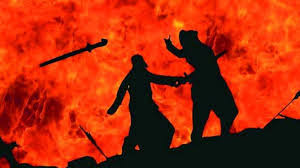
Present generation may not concern with Caesar and Brutus, but they certainly remember Kattappa and Amarendra Bahubali. Kattappa ws a slave and initiated into serving the Royal family of Mahishmati. The internal politics of Mahishmati conspires to utilise Kattappa to kill Amarendra Bahubali. Amarendra is killed by a trusted lieutenant Kattappa, though Kattappa later realises that he was fooled and used as a tool to kill Bahubali. Kattappa was an unwilling element in the big scheme of things, but he did kill Bahubali in the most unexpected circumstances. Kattappa did repent later but the action was irreversible by then.

*****
Mukunda Rao was unable to see things clearly and went for an eye check up. The Optician identified that cataract had developed in both eyes and surgery was required. As the first step in the direction of surgery, the retina of the eyes had to be scanned. He was directed to the optometrist for this purpose. The Optometrist asked Mukunda Rao to place the eye in place on the scanner and open the eye widely for a proper scan. As the scanning was in progress the eye got narrowed and closed. Optometrist tried three times but each time the eye drooped and scanning stopped. The Optometrist got frustrated and harshly told Mukunda Rao to keep the eyes wide open. Mukunda Rao said he wants to keep the eye open but it is getting closed involuntarily. The Optometrist summoned an assistant and made her hold the eye open and finished the scanning!
*****

Scanning was done, date for surgery was fixed and completed successfully. After the post-operative care was completed and the time came for prescription of glasses Mukunda Rao sat again before another Optometrist. As the examination of eyesight was in progress, Mukunda Rao asked the Optometrist which of the two images he should concentrate on. Optometrist was baffled and asked whether he was seeing two images all the time. Mukunda Rao said it happens sometimes and he can see a single image clearly at other times. Optometrist said the vision will stabilise once the spectacles are used regularly. Mukunda Rao paid a heavy amount for the fancy new spectacles and started using it. He was now seeing fancy double images and could not understand how many steps are there on the stairs or whether the footpath was even or uneven. The problem of double vision remained despite cataract surgery and the new fancy spectacles. Mukunda Rao now knew a new word - Diplopia. Diplopia is the name for double vision.

*****

Vamana Murthy attended all social and religious functions in his circle. He was often called upon by his friends and relatives to speak to the gatherings on such occasions. Being a teacher and trainer, he was comfortable in such roles and could speak extempore and keep the gatherings occupied during such events. He was also invited as a speaker or chief guest at many functions. Of late he started feeling that the spoken words were not clear sometimes and the speeches were slurred on occasions. This was more pronounced towards the evenings. Vamana Murthy now started to avoid attending the social and cultural gatherings.

*****
Madhusudana Rao took fancy to the new generation of smart watches and purchased a premium model that recorded various daily activities. The watch spurred him into longer walks in the morning at the friendly neighbourhood park. The statistics on walking show that the average number of steps taken by people allover the world is about 5000 in a day. Madhusudana Rao started with this goal and progressively increased the daily limit. He crossed 15000 steps on most of the days and took pride in his achieving daily goals. He observed that things were not the same of late and he got exhausted and felt shortness of breath even with small walks. Walking that was such a pleasure now became a tedious exercise.
*****

Narendra Rao was fond of savouries with a liberal spread of cashew nuts, almonds and groundnuts. A small quantity of mixture would accompany the evening cup of tea or coffee. All the teeth were in good shape and chewing these items leisurely and enjoying with coffee or tea was a pleasure especially on weekend afternoons. Things changed suddenly and Narendra found it difficult to crush and chew the almonds in his jaws. Groundnuts were alright, but harder nuts like almonds were a different nut to crack. He slowly started to remove the almonds and throw them away when other members of the family were looking elsewhere. Swallowing the chewed food also became difficult in due course. When he tried to push the liquids through the gullet, instead of going through the throat the liquid came out through the nose! Quantity of food consumed came down drastically and weakness in the muscles set in slowly. Swallowing the daily dose of tablets also became a big task.
*****
Kumaran was very active and would get ready to go to office or outdoor visits in a jiffy. The process started taking more time now. Buttoning the shirt sleeves needed more efforts. Picking things kept in the higher shelves also started posing problems. Spreading cloth for drying and similar chores took more effort now. Hours spent in sound sleep got reduced and there was a general dullness in the routine. Breathing became a strenuous exercise and would disrupt the sleeping pattern.  
*****

With the increase of awareness about physical fitness and health care, one would normally run to a doctor when confronted with the above problems. These symptoms are generally treated as originating from stroke or ENT issues. Ophthalmologists are expected to identify this promptly, but that is not always the case. Treatment for cataract is often confused for setting right double vision which is not true.

Myasthenia Gravis (MG) is a disorder that worsens after periods of activity and improves with rest. The symptoms mentioned above are worse as the day progresses and the persons dealing with these are better off in the mornings. But the situation would aggravate if not diagnosed early and remedial action initiated.  

MG is an autoimmune disorder, in which the immune system of the body that is expected to protect the body from outside organisms mistakenly attack the body itself. This is similar to the situation where the watchman attacks the master. Myasthenia Gravis is caused by an error in the transmission of nerve impulses to the muscles. It is said to occur when normal communication between the nerve and muscle is interrupted at the neuromuscular junction, where nerve cells connect with muscles they control. Technical details are  available on the internet and medical journals.

The typical symptoms of MG are:
  • Drooping f the muscles of one or both eyes.
  • Double vision or Diplopia.
  • Impaired speech, especially towards evenings.
  • Difficulty in chewing and swallowing.
  • Shortness of breath even in cases of short walks or physical activity.
  • Difficulty in breathing and shortness of sleep.
  • Weakness in hands, legs, fingers and neck muscles.
Myasthenia Gravis cases are rather rare and only some 15 to 20 cases per million population are said to carry this disorder. It is not contagious and does not run in the family. It can happen at any age group or gender. Though the disorder is itself rare, extensive research is done on this and advanced treatment is available.But unfortunately many cases go undetected and patients suffer silently and lead to what is known as Myasthenia Crisis.

When the muscles that control breathing weaken Myasthenia Crisis develops and the person requires ventilator support to breathe. Infections, stress or surgeries may trigger this crisis. Care must be taken to prevent slipping into such crisis.

Despite the issues relating to MG, people can lead a normal life by suitably changing life style and proper medical care. There are many prominent personalities with MG disorder and yet managing successful lives and leading in their respective fields.
*****

Anyone suffering from the symptoms mentioned above would do well to take a precautionary test after getting suitable medical advice.

The hidden enemy can be managed and controlled once identified!

Wednesday, October 26, 2022

Our Lifelines - The Rivers


A news item 
dated 2nd November, 2021 in Bangalore Mirror screamed - "No amount of rain can put life in Arkavathy river". It made a sad reading for many of us who were born and brought up on the banks of this river. Arkavathy has been a part of our innumerable childhood memories. Having been an integral part of our lives in the formative years, this river water was the taking care of the needs of the residents of all villages and towns along its banks as well as of Bangalore City, till 1974. The reservoirs at Hesaraghatta and Tippagondana Halli were the main water supply sources to the city.  Hesaraghatta reservoir was constructed in the year 1894, as a first source of drinking water to Bangalore. As the city grew and population increased, another reservoir at Tippagondana Halli was constructed in the year 1933. Illustrious names like K Seshadri Iyer and Sir M Vishveshvarayya are associated with the constructions of these two reservoirs.  As the demand for water increased due to further growth of the city, waters of the Cauvery river were brought in from about 60 miles, near Tore Kadanahalli, in the year 1974. We have now reached a stage where even this arrangement is not sufficient to meet the growing needs of the mega city.

The many "Neelanji" trees on the banks of the Arkavathy river, with their many roots playing in the river waters, provided a wonderful setting for river waters users. There was regular flowing water in the river during rainy seasons. There was some source of water below the sands of the river bed throughout the other months of the year. Urbanisation and excavation of sand from the river bed for decades for roads and other building constructions sadly removed this source. The headline in the newspaper did indeed burn our hearts. 

As if to prove that the river can be brought back to life, the copious rains in Bangalore and surrounding areas in the first week of August 2022 created heavy floods in the river Arkavathy! The floods have been compared to the flood in 1962, sixty years ago when we were in schools and visited the flowing river in our town. Though many rivers have been destroyed due to mindless urbanisation, it is not late even now to remedy the situation, this floods in Arkavathy show.

Recordings of the details of Bangalore's surroundings detail that there were over 300 lakes served by this river, starting from its birth place in Nandi Hills until it merged with river Cauvery just before the famous "Mekedaatu". All these lakes have been mercilessly encroached over the years and land sharks have converted them to residential colonies. A cabinet minister of Karnataka is on record of having said in the state assembly that the administration was forced to fill all the lakes to solve the problem of breeding of mosquitoes! Everyone knows the real reasons for filling up these lakes. The innumerable housing and commercial complexes that have come up on these tank beds are a living testimony for the actions of real estate developers. Whenever there are heavy rains in the area there is regular flooding of water in the houses and buildings in these encroached areas. 

*****

Rivers have been the arteries and veins of all life on the planet Earth. With their many uses to support all forms of life, rivers have been cradles of civilisations all round the globe. Water is available in many sources on earth; oceans, lakes, wells etc. Rivers provide flowing water and when not polluted, provide fresh potable water at all times. Modren way of life has brought in many dangers to the rivers and their existence. The froth-laden waters of Yamuna flowing near Delhi and Agra is a burning example of our callousness towards rivers.

We in India often remember river Saraswati as one of the sacred rivers. It is believed as a mythical river now. There are many theories about this river. Some claim that the river was flowing in westren India, comprising the present westren parts of India, present day Pakistan and Afghanistan. There are also theories that the river flowed and merged with Ganga and Yamuna in Prayagraj (Allahabad) forming a "Triveni" Sangam. There are a group of people known as "Saraswat" who are believed to have originated from the banks of these river, but now spread over various parts of the country, more so in Maharashtra, Goa and Gujarat. We have not seen this river in our life time. But her name is chanted on a daily basis by many Shraddalu people allover the country.

We have never seen river Saraswati flowing during our life time, yet there are many rivers we saw in our life time, but are now only existing by name and with no water flowing in them during most parts of the year. Cutting down forests and converting them into other purposes have dried up their origin sources which fed water to them. These rivers were well and truly alive when we were children and we have fond memories of having lived by their sides and played in their waters. We have also seen floods in them almost every year. But by the time of our children and grand children, they are existing only in name. Names of some of these rivers are also being forgotten now. This is the price we are paying for unplanned growth and greedy needs of our civilisation.

*****

A journey from Bangalore to Delhi by train would take two full days in the 1960s. Travelling by air was not an option in those days for most of the people. The 48-hour journey was itself enjoyable and provided an opportunity to cross many rivers on the way. Youngsters would sit on the window seats and wait to see these rivers. The blue waters in some of the big rivers was a treat to watch, especially in the hot summer months. Throwing coins in some of the rivers considered sacred was also seen. Crossing Krishna, Godavari and Narmada rivers was indeed memorable.

Even a small trip of 90 miles (140 KM) from Bangalore to Mysore by train or bus would give a glimpse of a number of rivers on the way. There was Vrushabhavati as soon as one left Bangalore and gave company for some six miles, flowing by the road side. Arkavathy would show up in Ramanagaram, followed by Kanva river after Channapatna. Shimsha would show up just before Maddur. Lokapavani before Srirangapatna heralded East Cauvery and Paschima Vahini, the two branches of Cauvery. As railway locomotives were steam engines, Ramanagaram, Maddur and Srirangapatna were known as water stations. It was a thrilling sight for children to see water being filled into the engines in these stations. As Maddur was near the mid point, the water filling time was also providing an opportunity to the passengers to enjoy the famous "Maddur Vada"

There are many tourist spots along these rivers. Ranganathittu Bird Sanctuary is one of the major tourist attractions in the area. Many film scenes have been shot in the surroundings of this bird sanctuary. One of the popular films "Paakeeza" has riverside and boat scenes shot in this area. The immortal song "Chalo dildar chalo, Chaand ke paar chalo" is filmed in the area between Ranganatittu and GaganaChukki and BharaChukki water falls.

Kanva Resorvoir is a water storage dam constructed on the Kanva river and situate about 8 miles away from the town of Channapatna on the Bangalore - Mysore Highway. It is a scenic spot and popular among the youngsters for picnic and hiking activities. 

*****

When we think of the rivers we see on the way from Bangalore to Mysore, we also recall the famous temples along the road. Among the many temples are Ramadevara Betta near Ramanagaram, Ambegalu Krishna just outside Channapatna in Maluru, Ugra Narasimha and Varadaraja in Maddur and Sri Ranganatha in Srirangapatna.

The Ambegalu Krishna or Aprameya Swamy in Maluru on the banks of Kanva river, just outside Channapatna is a popular stop for many travellers between Bangalore and Mysore. Legend has it that the king ruling this area married a young girl at his old age. Kings were known to have many wives and many of these marriages were a result of political alignments. When a war is lost, the losing kings often offered their daughters in marriage to the winning kings. This king had a young and handsome son from an earlier marriage and he was expected to succeed the throne. The king's young wife took interest in this young prince and desired to develop relationship with him. The young man refused and advised her that their relation is of mother and son and they should stick to it.

The slighted stepmother went to the king and complained about the prince that he was behaving badly with her. The king ordered that the prince's legs be cut off and and he be thrown into the Kanva river. The orders were carried out. The elderly minister approached Sri Brahmanya Tirtha, a sage in the nearby village Abbur, situate on the other bank of the river, to remedy the situation. It is believed that Sri Brahmanya Tirtha gave holy Mrittika (mud) and advised that it be applied on the wounds. In due course the prince's legs started growing and he became normal. The temple got the name Maluru, meaning the germinating process in the local language.

Of course, there are many other versions of the story about the temple and how the place got the name Maluru. The idol of Krishna with a bowl of butter in his hand is beautiful. It is believed that Sri Purandaradasa composed the song "Aadisidaleshoda jagadoddharana" at this temple. The festivities at the temple reach the peak during Krishna Jayanti celebrations. Many people from nearby areas converge to worship at the temple during these days.

Friday, May 21, 2021

I Am Not Yet Ready


What is the difference between human beings and animals? Can the difference be defined with a most notable single feature? It is the capacity to think, understand and relate. The human brain works at different levels at the same time. It takes in multiple inputs, sorts and understands them, store and retrieve the required parts as and when desired. There is also the capacity to transfer these stored and accumulated information and knowledge. Some animals also display such qualities but they are to a very limited extent. Dogs and Parrots are the best examples. Other animals are also trained to do certain actions and used in shows and circus. Some of them like Elephants are used to work as well so that the life of humans is simplified and made easy. But all these meet with limited success. This basic distinction also results in the capacity of human beings being able to visualise things, plan their execution and act decisively to achieve those plans. This makes human life interesting as well as complicated! 

Human beings visualise, plan and execute those plans. This requires action or a series of actions. As a human being is executing many plans simultaneously, there are multiple sets of actions in implementation at any point in time. In case of team tasks, there are multiple sets of actions being implemented by each member of the team to achieve the common goal. 

What are the basic objectives behind all these actions? This is a very interesting question. One of our well known ancient philosophers Kumarila Bhatta has quoted from Parashara Samhita (Verse 59 of 13th Chapter) that even a stupid person will not venture into something without evaluating its utility  (प्रयोजनमनुद्दिश्य न मन्दोपि प्रवर्तते - Prayojanamanuddishya na mandopi pravartate). His evaluation may be defective, but it is another matter. This being the case why does a person act in a given direction?

Each action has two basic objectives; to get rid of some difficulty or sorrow and achieve some pleasure (दुःख निवृत्ति, आनंद प्राप्ति). Thus many actions lead to a second situation (action) to rid of an existing situation. The funniest part is that each pleasure so derived often brings its own pain either immediately or with a time lag. This leads to a further action and so on....

The above chain is very well chronicled in the birth of Draupadi in Mahabharata. 

***** 

Sage Bharadwaja is one of the Saptarshis, the seven revered sages, and is credited with immense contributions to our Vedic literature, Ayurveda and many other branches of learning. He is the son of Devaguru Brihaspati and devoted his entire life to learning and teaching. He had taken a vow of celibacy and remained a bachelor. One morning he was going to the river near his hermitage to take bath and start his daily routine. Ghrutachi, a celestial nymph (apsara) had just finished her bath in the river and came up. A strong wind blew away the thin cloth she was covering herself with. She recovered her cloth and went away. Rishi Bharadwaja saw her and for a moment his mind was severely disturbed. Surprised at the happening, but satisfied that this was due to some cosmic will of the Lord, he collected the semen in a vessel made of leaves. In due course of time, a handsome boy came out from the pot. The boy was named as Drona, as he was born not from a mother's womb but a Drona, a container made from leaves. 

Sage Bharadwaja brought up the boy by giving him proper education. The prince of Panchala kingdom, Drupada, joined the gurukul of Bharadwaja. Drona and Drupada became close friends. Drupada once promised that when he becomes the king of Panchala, Drona can have anything he wants, even half of his kingdom. In due course, Drona came to be known as Dronacharya and was appointed by Bhishma as the Chancellor of the Archery and Weapons Training School in Hastinapur. Drupada became the king of Panchala. Dronacharya married Krupi,  the sister of Krupacharya, Guru of the Hastinapur kings. The son of Dronacharya and Krupi was named as Ashwatthama, who later became an important General in the army of the Kauravas.

Dronacharya was leading a contented life with Krupi before coming to Hastinapur, without asking any favours from anyone else. Young Ashwatthama was being given rice flour mixed in water as milk. After becoming friend with Duryodhana, once he had a chance to drink the real milk in the palace. Ashwatthama demanded that he be given real milk henceforth. Krupi persuaded Dronacharya to approach his childhood friend Drupada, who had now become a king, for getting a cow so that Ashwatthama can be given proper milk. Though unwilling, Dronacharya went to king Drupada. Drupada laughed at his friend and said there cannot be any friendship between a king and a pauper. Enraged at this behaviour of Drupada, Dronacharya took a vow that he would have Drupada captured by his disciples to teach him a lesson. A new set of actions were set in motion now.

At the convocation of the Archery and Weapon School in Hastinapur, the issue of giving "Guru Dakshina" (a fee by the student to his teacher) came up. Dronacharya used the opportunity and told kauravas and pandavas that he would like them to defeat Drupada, capture and present him at Guru's feet. Kauravas went first but were defeated by Drupada and his army. Pandavas went in next and Arjuna succeeded in in defeating and capturing Drupada. Dronacharya pardoned Drupada and sent him away saying that he is now gifting away the entire panchala kingdom to Drupada.

Now it was the turn of Drupada to feel insulted. He was extremely impressed by the bravery and skills of Arjuna. He now decided that he would do something to get a son who would kill Dronacharya to get his revenge. He will also get a daughter so that he can make Arjuna his son-in-law. The twin desires now put a further set of actions in motion!

*****

The task was not an easy one. There must be some method to achieve these twin objectives, Drupada thought. He entrusted the kingdom to his ministers and set forth in search of someone who could guide him to achieve his goals. He went to the forest and found a Rishi who appeared competent to guide him. The rishi was Upayaja, a brother of rishi Yaja (Similar to Indra and Upendra, Upa meaning younger brother). After hearing Drupada's request, Upayaja refused and said that he is not willing to get involved. On repeated requests by Drupada, Upayaja said that he can approach his elder brother Yaja who may accept his request. After serving Yaja for a long time, he agreed to do a holy ritual (Yagna) to achieve the objectives. But Yaja put a condition; it was not possible for him to do it alone and his brother Upayaja should join him in the conduct of the ritual! Drupada was now again forced to go to Upayaja. Upayaja agreed to assist Yaja as it was a command of his elder brother. The two brothers made all arrangements and started the ritual.

The time was set for the ritual. Drupada and his wife Queen Prishati started the proceedings. After the initial phase, Prishati was permitted to attend to the guests and arrangements at the site and advised to be available as and when called to take further part in the ritual. At the conclusion of the ritual, a divine messenger appeared from the fire and handed over the "Yagna Phala" to Chief of the ritual, Rishi Yaja. Yaja advised Drupada to call his queen Prishati to join him to receive the Yagna Phala. When the queen was called to the site of the sacred fire, she said "I Am Not Yet Ready" to receive the Phala as she was busy with some chore and had perfume in her hands. Enraged at this Rishi Yaga shouted and said that the divine events do not care whether anyone is ready to respond to them. He said that a ritual done under the leadership of Yaja and Upayaja cannot go waste nor can it wait for someone to come. He put back the yagna phala back into the sacred fire with a prayer.

As a consequence of this, a remarkable boy of about 14 years in shining armour emerged from the fire. Following him, a very beautiful girl with dark complexion emerged from the fire. The boy was named Drishtadyumna and the girl was named as Krishnaa due to her complexion. She was later known as Draupadi, the daughter of Drupada. The one born without a mother's womb (Dronacharya) was now destined to be killed by another born without a mother's womb (Drishtadyumna). Another set of actions were set in motion now.

Queen Prishati was now crestfallen. She had looked forward to be a proud mother of divine children, but now was deprived of this distinction. She was also worried as to how the two children would deal with her now that the bond a mother had with her children she delivered is absent. She requested Yaja and Upayaja to bless her. The two brothers recognised her position and gave her a boon. "The two children will treat you as if you have given birth to them. You will enjoy all the blessings and happiness a mother can expect from her children. Shower your love and affection on them as well", they blessed her. Thus ended the saga of the sacred ritual, but it was only sowing the seeds of the future actions.

*****

In all such sacred rituals, Yagna Phala results in the couple getting children delivered by the mother, but this was an exception when the children emerged from the sacred fire itself. It is a very interesting and intriguing story. 

Is there a lesson in this for us? Revenge opens the gates for another revenge, is the first one. Forgiving and starting a new chapter in one's life is more beneficial than keeping old wounds open and seeking to settle scores with our friends who may sometimes offend us. Understanding that elders and events do not wait for us and we should be ever ready, is the second. The main objective should not be forgotten while looking into allied things, one should remember. If and when something adverse happens, one should try to retrieve and salvage whatever best is possible, as done by Queen Prishati, is the third.

Do you find any other lesson as well?