Saturday, February 25, 2012

With Wife, On Official Duty

Performance of the Indian Cricket Team has really gone "Down Under" in Australia.  The failure in Test series was conveniently blamed on the seniors in the team, especially VVS Laxman and Rahul Dravid.  Questions were raised about their continuance and all pundits, semi-pundits and non-pundits unanimously declared that they should retire. "To retire or not to retire" (Click on this to read this post)  was the question posed to them.  The test series is over now and they are off the hook for the time being.  Focus shifted to the "One day Tri-series" between India, Australia and Srilanka.  The younger and fitter players were on the field and initially they were praised for their wonderful performance.  Within a fortnight that also evaporated and  we are back to the same pitiable situation with the younger lot also.  Funnily enough, now the older among the younger lot are blamed for the poor showing.  Critics deserve to be congratulated.  With each poor performance on the field, they are able to find an unending supply of scape goats.  We are also to be blamed for the present mess.  Instead of being grateful to these players for continuing to play the game despite the extreme demand on their time to take care and invest the large sums of money, for which they are being repeatedly auctioned in IPL and other circus, we still expect them to win matches.

One of the reasons attributed for the poor performance of the Indian players in the past was the presence of their wives with them during tours abroad.  Add girl friends also in case of those who are not yet married.  These wives and girl friends were often cited as the reason for poor and dismal on-field performance of the players.  Questions were also raised as to who was footing the bill for their travel abroad.  This was despite the clear knowledge that our millionaire cricketers were eminently capable of meeting the travel cost of their entire neighborhood if they so desire.  Fortunately  Air India was not involved in this saga as otherwise there could have been stories about smaller planes being replaced by bigger ones to accommodate the larger and extended families of the famed cricketers on such tours.  After all our cricketers are no less than some minister or politician.  Just look at how each one of them is being misquoted so frequently and how they are blaming each other.  We do know that some of our cricketers have successfully contested elections and became our official representatives in legislatures and parliament.  Not only successfully contesting the elections but also remaining in limelight thereafter.  Not for their illuminating or inspiring speeches in the debates of the houses,  but for beating up some hapless person on the streets.  One has to express deep regret that no statistician is coming forward to keep a record of the number of persons beaten up.  And thus depriving us of the valuable knowledge as to who has been the most consistent beater of hapless persons and the average beating record of these ex-players.

Presence of wives on tours reminds me of an anecdote told to me by a friend.  A General Manager of  a Public Sector Undertaking went to a big city on an official tour.  After his return to headquarters, Managing Director (MD) of the undertaking received a complaint that the General Manager was accompanied by a woman on tour and stayed at the hotel on official expenses.  MD commissioned a discreet inquiry to find the truth about the complaint.  The investigations revealed that the complaint was indeed true and the General Manager had actually stayed in a Hotel with a lady during the official tour.  It was also found out that she was actually his only wife and there was no effort on GM's part to conceal this and this was clearly told to the Hotel management.  It also came out that the GM had not charged even a single rupee in excess of his entitlement and he had actually paid all additional expenses arising due to his wife's presence from his own pocket.  It further came out that he had also discharged his duties of the visit as expected and did not spend any time with his wife when he was expected to be on duty elsewhere.  The GM was naturally peeved at this complaint and so expressed to the MD.  The Managing Director laughed and told the GM; "You should be actually happy about this episode.  It has shown what sort of a man you are.  In fact, it is a "Character Certificate" issued to you by the complainant!".

A similar scene is portrayed in a Kannada film, "Kaaleju Ranga".  As the name itself suggests, this film is about the events that unfold in a College.  A college where internal politics and individual likes and dislikes push academics into the background.  The film itself was considered an average one though it was directed by one of the best directors, Late Puttana Kanagal.  A complaint is made about Professor Devaiah,  eminently played by Kalyan Kumar, that he was found in the "College Laboratory" with a woman late in the night.  An enquiry is conducted and he is questioned about his misdemeanor.  Prof. Devaiah accepts the charge that he was indeed with a woman in the college laboratory, late in the night.  he explains that the woman is none other than his own wife and she was in the lab helping him in his research work.  He had to take her services as he was not provided an assistant despite repeated requests and she was well qualified to assist him.  She was not paid any salary or allowances by the college.  While answering he gets emotional and finally thunders, "I was not in the lab enjoying my time with my wife.  For your kind information, I also have a house and there is also a bedroom in it".  Unable to frame him on this count his detractors set fire to the lab and all his valuable research papers and his hard work of several years is consigned to flames.

"Kaaleju Ranga"  film is based on a novel by Dr. B G L Swamy, one of India's eminent Botanists.  Prof B G L Swamy taught Botany in the prestigious Presidency College of Chennai.  He was also the Principal of that college for some time.  He was awarded "Birbal Sahni Gold Medal" for his research work in Botany.  He was also a writer of high value literary works and had the ability to communicate scientific information in true literary style.  Some of his works like "Hasiru Honnu" (Green Wealth) and "Namma Hotteyalli Dakshina America" (South America in our stomach) are very popular.  His "Hasiru Honnu" was a Central Sahitya Academy award winner.  He and his father D V Gundappa, popularly known as DVG, were the first father and son duo to win the prestigious Kendra Sahitya Academy award.  DVG is a highly respected writer and philosopher and his "Mankutimmana kagga" is a treasure of knowledge.  Younger generation will be greatly benefited  by reading the books of B G L Swamy and DVG. 

Saturday, February 18, 2012

All for that one Night

There was a sudden and heavy excitement in the air and shouts of joy just outside our house one evening, several years ago.  I was preparing for a presentation at office on the next day and this shouting annoyed me.  I went out to see the source of excitement.  Across our compound, in the neighbor's house stood a small plant in a flower pot and it was the center of all this attraction and celebration.  The "Brahma Kamala" plant had flowered that day, and that too on a Full Moon Day.  The beautiful flower was being photographed repeatedly and all the animated discussion was about the flower.

Epiphyllum Oxypetalum is the botanical name for the flower shown in the photograph alongside, downloaded from Internet.  This flower is called "Brahma Kamala" in our area.  It has several names like Dutchman's Pipe, Night Queen, Nishagandhi (Sanskrit and Hindi word for night blooming fragrant flower), Gul-e-Bakawali etc.  It is a type of cactus plant flower.  It is called "Kadupul" in Srilanka, meaning a flower of the forest.  Japanese call it "Beauty under the Moon" and Chinese compare a brief but impressive moment in some one's life to this flower.   This flower rarely blooms and that too only at night.  It is said that the plant flowers only once a year.  But the flower lives for a night only and withers away by sunrise.  The plant lives for a year to give out a flower after a year and the life of that flower is one night only.  All for that one glorious night.  

This is an all white flower as can be seen in the picture.  A slightly different variety of this plant found in Mexico is said to have red outer petals and the flowers have an unpleasant smell instead of being fragrant.  The atmosphere on the day the flower bloomed in the neighbor's compound was full of fragrance.  I mentioned about this fragrance two or three times when a friendly lady from another neighborly house pulled me aside and told me to keep quiet and not to talk about the fragrance.  She further explained that it was not the fragrance of the flower that filled the atmosphere, but the perfume generously sprayed by another lady in the group on her person.  I do not know till today whether it was a fact or it was due to jealousy.  I also do not know the real fragrance of the Brahma Kamal flower as I have not been able to see another one bloom since then.

Oxypetallum flower is a one night story once in a year.  There is a palm tree in Lal bagh, Bangalore which flowers once in sixty years.  This tall tree flowered about ten years ago and anyone visiting Bangalore wanted to see that tree with the rare bloom in sixty years.  Unlike the Oxypetalum  flower's one night life, this palm tree flower was entertaining the visitors for more than a month.  I had to make four visits to Lalbagh during that month, with the guests and each visit was preceded or followed with a Masala Dosa in the nearby Mavalli Tiffin Rooms, popularly known by its short name, MTR.  Probably the palm tree was celebrating its "Ugra Ratha Shanti", or sixty-first birthday and our feast was regularly arranged in MTR!

Talking of flowering once in sixty years, I recall a news item in "Deccan Herald" last month, on 18th January 2012.  It was reported that all the Bamboo trees in in the forest of Koppa taluk in Karnataka had bloomed fully at that time.  There is an apprehension that the crop may perish completely as the flowering of Bamboo trees also happens once in sixty years!  Once the Bamboo trees die after flowering, they do not grow for ten years.  Birds which live in the Bamboo grooves have to migrate and find place elsewhere.  There is also a possibility of  wild fires due to the dry bamboo shoots and leaves.

Whether it is a one night life of Brahma Kamal or one and half month long visible flower of the Palm Tree or even the once-in-sixty year flowering of bamboo trees, nature has its own secrets and surprises for us.

Friday, February 17, 2012

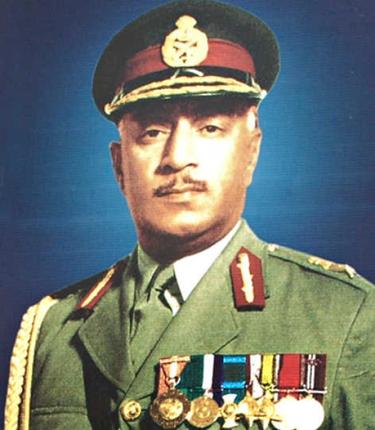
The General and a Diplomat

One of the definitions of a diplomat in on-line dictionary is "a person who is tactful and skillful in managing delicate situations, handling people, etc". This definition of a diplomat applied well and truly to General K S Thimayya, one of the most distinguished soldier and leader of our country. Kodendera Subayya Thimayya, popularly known as "Thimmy" among his colleagues and friends, proved his outstanding leadership skills and capacity to handle delicate situations many times during the turbulent times of World War II, Indian Independence, Partition and thereafter.

Last year I had to visit Madikeri (Coorg) on some work and met a few leaders of the Kodava community. Madikeri being the birth place of Gen Thimayya naturally aroused some curiosity in me and I also visited a school run by the "Kodava Samaja" in the name and memory of the General. My thoughts raced back to over forty years ago when we as school boys used to move from one cricket match to another on Sundays, to watch Y S Ramaswamy Shield or Mirza shield matches. For the benefit of present generation cricket enthusiasts, Y S Ramaswamy was a leg break bowler from Mysore and while playing for Marimallappa High School against Methodist school claimed all the twenty wickets in the match, all the ten in both innings! The feat was achieved in the "Oval" ground opposite to the famed Crawford Hall of Mysore University. Some YSR and Mirza shield matches were played in the St. Joseph's Hostel field near end of Double Road and Richmond Circle. The best place for lunch after an excellent morning session was "Woodlands Hotel" nearby. As we walked to the hotel from the field, the corner house in the lane before the Woodlands hotel used to attract my attention. On the stone pillar near the gate of the house was a stone name slab. The specialty of the slab was that it was in the form of a signature - signature of Thimayya with the word "General' below it. I have seen this sign till 70s and later on it disappeared probably because the house was sold or some other reason. The Richmond Road which merged into the nearby Richmond circle (which has again disappeared and replaced by a flyover) is actually named after General Thimayya, but continues to be known as Richmond Road.

The bravery of Kodagu people is well known and most of the houses in Kodagu district have at least one of their family members in the Indian Army. Some families have three or four as well. Panje Mangesha Rao was a school inspector and head master of Madikeri High School. He is well known for his famous songs "Nagara haave, haavolu hoove, baagila biladali ninnaya thaave" and "Tenkana Gaali". His "Huttari Haadu" graphically describes the bravery and courage of kodava people. Some lines from his poem are still fresh in memory and the summary runs like this:

"When they were hungry in the forest, they caught hold of a tiger and drank its milk; when the rubber tied to their caterpillar was broken they tied a python in lieu of it;  those who used the trunk of an elephant to blow a horn and those heros who were a symbol of valour; those are the heroes of kodagu, those who do not know what defeat and death is". Title of the famous Kannada film "Huliya Haalina Meevu" is derived probably from this song and the story of the film is also about Kodagu heroes. Gen Thimayya belonged to this exalted tradition.

Gen Thimayya belonged to the "Kodandera" clan to which Field Marshal Cariappa also belonged.  Timmy and his two brothers joined the army.  His elder brother Ponnappa later joined Azad Hind Fouz ( INA) and his younger brother Somayya died in the Kashmir operations of 1947-48. His mother was a recipient of the prestigious "Kesar-e-Hind" title for her philanthropic activities. After his education in St Joseph's schools in Coonoor and Bangalore he was commissioned in the British Army in 1926. He showed great promise as a young  officer and led his regiment in Burma with record success. Sir Claude Auchinleck, Commander-in-chief of the Indian Army was impressed by Timmy's leadership qualities and he was assigned to lead forces fighting the Japanese in Second World War. His was a delicate assignment; he was an Indian officer serving under British leadership and dealing with the American General Douglas MacArthur, who was the Supreme Allied Commander of the Southwest pacific area, and fighting the Japanese. Timmy's remarkable diplomatic skills and reputed leadership qualities were appreciated by allies as well as enemy force commanders. When the 2nd battalion of Gurkha Rifles resorted to sit-down strike in Tokyo refusing to obey the British officers, Timmy was called in and he successfully defused the situation.

General Thimayya represented our country during the surrender of the Japanese in Singapore and signed the surrender document on behalf of India. When he went to Philippines, he was awarded "Keys to Manila" in recognition of his services, which is a rare honour for a military officer.  At the end of the second world war, he was called back to India and he was a distinguished member of the committee that supervised sharing of weapons, equipments and regiments between India and Pakistan. During the Kashmir operations of 1947-48, he personally led the attack against the insurgents. His diplomatic skills were again recognised when he was selected by United Nations to head Neutral Nations Repatriation Commission in Korea. He successfully accomplished the tough assignment of handling the Chinese and Korean prisoners.

He reached the heights of his career when he became the Chief of Army Staff  in 1957.  He resigned his post when he had differences with Defense Minister V K Krishna Menon, but Prime Minister Jawaharlal Nehru did not accept it and he continued in his post. After his retirement in 1961 he was again called by United Nations to lead UN forces in Cyprus where he died while on duty due to heart attack. Republic of Cyprus honored him by releasing a commemorative stamp in his memory. One of the roads in Cyprus was also named after him.

General Thimayya is a good name to remember during the present days when there is a strain in the relationship between the civilian and military leadership. General Thimayya was a winner on both tracks, diplomatic as well as war fronts.  General Thimayya and his wife are also remembered for the selfless service they rendered to the victims of the "Quetta Earthquake" in 1935.  A true soldier and human being, in the glorious Kodava tradition.

Monday, February 13, 2012

I am no THIEF, Mom!


Last week I had made a post titled "GrandFather and GrandSon" (click here to read it). Some friends have mailed me asking for similar stories. Saint Purandaradasa has left many such stories for us, in the form of beautiful songs. These songs were sung daily in almost every household some decades ago. Pressures of modern life and  change of life style have rendered such songs redundant. "Jack and Jill" and "Humpty Dumpty" have replaced those songs.


*******

ನೀಲವರ್ಣನೆ ಕೃಷ್ಣ,  ನಾರಿಯರು ನಿನ್ನ ಬಲು ಚೋರ ಎಂಬುವರೊ ಕೃಷ್ಣ
ಗಯ್ಯಾಳಿ ಶಟವಿಯರ ನುಡಿ ಕೇಳಿ ಎನ್ನ ಮೇಲೆ ಕೋಪವನ್ನು ಮಾಳ್ದೆಯಮ್ಮಾ, ಗೋಪ್ಯಮ್ಮ

ಬಡವರರಾಮನೆಯಲ್ಲಿ ಕೊಡ ಹಾಲು ಮೊಸರು ನೀ ಕುಡಿದುಬಂದ್ಯಂತಲ್ಲೋ ಕೃಷ್ಣ?
ನಾ ಹುಡುಗ ಕೊಡ ಹಾಲು ಕುಡಿವ ಬಗೆ ಹ್ಯಾಂಗಮ್ಮ, ಇದ ನಿಜ ಮಾಡಿ ತೋರಿಸಮ್ಮ, ಗೋಪ್ಯಮ್ಮ
....................

Neelavarnane Krishna, naariyaru ninna balu chooranembuvaro krishna
Gayyali shataviyara nudi keeli enna meele koopavanu maaldeyamma gopyamma!

Badavaraa maneyalli koda haalu mosaru nee kudidu bandyantallo Krishna?
Naa huduga koda haalu kudiva bage hyaangamma, ida nija maadi torisamma, Gopyamma

*******

Yashoda is in a very angry mood. She is fed up with umpteen complaints on Krishna from almost every one in the area. Some of the complaints are unbelievable and her heart does not permit her to accept them. But she cannot ignore them also. This boy is also very mischievous and she herself knows his exploits at home. Complaints are made by the women when Krishna is not around. When  Krishna is with her and she questions him, he manages to digress and her motherly love makes her adore her son and forget the complaints. All the complaints are repeated the next day. She has decided to put an end to all these complaints. Little Krishna is strictly admonished and tied to the wooden pillar. He has been denied his share of  butter in the morning. Krishna is weeping  and begging his mother to release him.  She strongly rebukes him again. He is firmly told that he will be released only after the complaints are sorted out in the afternoon. Krishna promises her that he will stay at home and be available when all the complainants arrive. Yashoda does no relent. She knows very well that once released, she cannot find him easily. He may even run away to the banks of river Yamuna and start dancing on the head of some dangerous snake. She stays firm much against her motherly urge to release him. Krishna has stopped begging to be released. He appears hurt by the turn of events and two drops of tears, looking like pearls, are still on the edge of the beautiful eyes.

One by one the complainants are arriving in the palatial house of Nanda Gopa. Nanda Gopa is not at home. The court is in session. Yashoda is the presiding Judge. She is also the prosecutor. Many women from nearby streets are complainants. Accused Krishna is standing tied to the pillar. Balarama and other boys are just outside the main hall which is now converted into a court room. They are peeping through the window, anxious to know what is going to happen next. Yashoda  knows the list of complaints by heart and does not need any records to refer to. She has heard the complaint so many times.

"Krishna, this woman complains that you have gone to their house and stealthily drank a full pot of milk. They are very poor people. They make a living  by selling the milk. What should they do if a pot of milk is finished by you? Am I not giving you sufficient milk at home?"

"I am no thief, Mom. Do not believe this woman. You know I am such a small boy. My whole body can be put inside that big pot. Is it possible for my stomach to hold a pot of milk? See, how small is my stomach is! Let her bring a boy like me and make him drink a pot of milk.  Then we can accept her charge."

The charge is unsubstantiated and dropped. Yashoda takes up the next complaint. "Krishna, this other woman has a complaint that you took their sarees and ran away. What do you say for this?".  "Mom, I am only six years old and alone. They are sixteen years old, grown up and outnumber me. See my feet. How small they are. How can I run faster than them?". Charge is to be dropped again.

All other complaints are tried one by one. Krishna has a convincing reply to each charge. All charges are dropped and Krishna is released. He runs to meet his brother and friends waiting outside.

All the women come out of the palatial house. The first complainant comes to Krishna and begs him: "Krishna, please come to our house tomorrow. You can drink as much milk as you want. After your last visit our cow is giving three times the usual quantity of milk. Please forgive me and come tomorrow". Krishna smiles. Other complainants follow one by one. Each one requests him to visit their respective houses. Krishna is all smiles. Yashoda  comes in search of Krishna with a big ball of butter.

*******

Saint Purandaradasa must have observed children very closely. He probably saw a Krishna in every child around him. His was not a case of dry devotion to the Lord. It was devotion filled with humanly love and divine feelings.

Saturday, February 11, 2012

The "Centenary Men"

We stated with  identifying "Five Milestones in LIFE" and crossed "First and Second Milestones".  We took a view of  "The 1000th FULL Moon".  We saw the arrival of the great grandson in "Welcome, Great Grand Son". (Please click on the respective titles to read them).  That brings us to the ultimate peak, a life completing the full period of 100 years for the physical body.

There were innumerable stalwarts and great people who achieved a lot at a young age.  They did not live long but the society and mankind remembers them even today for their tremendous contributions in various fields.  Living for 100 years is not the only achievement.  But it is an incredible achievement; a successful test of endurance and a sign of life lived well over a long period of time.  Only a very small percentage of people reach this level.   Some of these "Centenary Men" have made notable achievements during their life time and every single day of their life is a testimony to a fruitful life.  They combined longevity with hard work and discipline in their lives.  Of course, there may have been a few who lived for 100 years and had nothing to show except that their heart pumped without a break for that length of time.  Even that is no mean achievement, to maintain the physical body in working condition that long.  But there were many who were known for their long lives as well as a matching lengthy list of achievements.  Let us celebrate the memory of such great personalities and draw inspiration from their lives.

As regards the shanti karmas after crossing this milestone, the usual rituals done in most of the earlier levels hold good.  The Presiding deity and other deities are invoked in the kalashas and worshiped in the prescribed manner.  Special mention is made of the Centenary at appropriate stages.  Sprinkling of holy water is done with golden flowers or ornaments in a sieve.  There will be the long queue of relatives and friends waiting for their turn to prostrate before the "Centenary Man" and seek his blessings.  The usual sumptuous feast will always be there.  The atmosphere reverberates with a feeling of achievement; not just the achievement of one man, but of everyone around!  An achievement of being able to be present and participate in such a rare and unique function.  Participation in a function about which one can take pride and remember for a long long time.

There are many lessons that could be drawn from the lives of the Centenarians.  A common thread in the lives of all these people is "Discipline".  Discipline in their food habits, activity levels and keeping the body and mind in shape and together.  These people have proved by practice and showed in reality that our vedic blessings like "Shatamaanam bhavati....." and  spiritual expectations of "Jeevema Sharadh Shatam, Pashyema Sharadh Shatam....." are not mere slogans or wishful thinking.  They are based on successful past experience and sound logic.  The mere fact that a majority of humans are unable to reach this level does not invalidate the very goal itself.  But achieving this goal is not a matter of chance.  It needs dedicated efforts.  For this one reason at least, they deserve our thanks and gratitude.  Our thanks and gratitude is also due to the family members of all Centenarians, sometimes and often of three generations, who have traveled with them on the long path for different lengths and at different times.  Some of them would not be physically present at the grand finale.  But they are to be remembered for their contributions.  Proper care, especially at advanced age, is very crucial and those who provided this basic requirement are indeed a key to such celebrations.      

There can be a question now.  Is there any other milestone thereafter?  We have to respect the laws of nature and the limitations of the physical body.  It would already have been pushed to its limits by this time.  We do hear that some people have lived longer than 100 years.  Many of these claims are difficult to verify as there were no proper birth records a hundred years ago.  There is an Organization by name "Gerontology Research Group" which verifies longevity claims and authenticates them.  Guinness book of World Records also verifies such claims before accepting them.  They maintain a list of such people called "Super-centenarians".  One Jeanne Calment of France lived for 122 years and 164 days!  There were authentic records in her native city, Arles in France.  Technically speaking, if some shanti karma is to be celebrated in our area as per the practice discussed in these blog posts, it should be at 120 years when the person enters the third sixty year cycle of the Lunar years.  That is more academic than in practice.

One friend of our family was blessed with a great grand son some years ago.  All her friends arranged a function  near Bangalore to celebrate the event in the form of a social gathering.  I was asked to speak about the significance of these celebrations.  I spoke for sometime on these five milestones and in the end asked them whether it is possible to cross all those milestones and whether they actually knew somebody who crossed all these five milestones.  There was a unanimous shout that it is not possible.  When I mentioned that there was one person who did so and that I was also present at the celebration, they were all excited.  When the name was mentioned, they all said they knew the person very well.  Justice Nittoor Srinivasa Rao,  former Chief justice of Karnataka High Court and India's first Central Vigilance Commissioner (CVC) was one such rare example.  When his centenary was celebrated he was surrounded by innumerable relatives and friends.  I was also one among the fortunate ones to be present.   His was an example of successfully crossing all the five milestones including the rare "Prapoutra darshana".   

Thursday, February 9, 2012

Welcome, Great Grandson!

After identifying the "Five Milestones in LIFE", we embarked on a journey of life through "First and Second Milestones"  and  "The 1000th FULL Moon" (Click on the respective titles to read these three blogs).  After these three important stages, the fourth milestone of "Prapoutra Darshana" or "Arrival of Great Grandson" is due to be scaled now.  I am using the word scaling instead of crossing, deliberately.  The next two milestones are like going uphill and they are nothing short of scaling peaks of mountains.

This milestone "Prapoutra darshana" is different from the other four milestones and hence it is indeed special.  Why is it different and how is it special?  Some explanation is required to understand its specialty and specific significance of this milestone.  There are two basic reasons making this special and distinct.  First reason is the order of its occurrence.  Second reason is the practical difficulty in reaching it.

The other four identified milestones are arithmetical possibilities and occur at specific time intervals which is automatically  fixed at the time of the birth of the child itself.  When the child is born, for example say in February 2012, the four events occur in 2072 (60 years), 2082 (70 years), 2094 (82nd year) and 2112 (100th year).  Further, all these four milestones have to occur one after the other in the same order for everyone.  But "Prapoutra Darshana" or the arrival of "Great Grandson" may sneak in between any of them or it may never happen at all during the life time of a person even though he may live for 101 years.  If a person gets married very early and has a son, and the same continues for the son as well as grand son, great grandson may arrive even before the otherwise first milestone of 60 years!  Marriage at 18, a son at 19, grandson at 38 and a great grandson at 57 or 58 is a define probability, though it may not happen in the present day situation of late marriages where arrival of the grand son before the end of their life's journey itself is a doubtful case for many.  But this was a definite possibility in yesteryear.

I have myself seen five generations of women in one place in my childhood, when girls were married at 12 to 14 years, though five generations of men eluded me.  The photograph given alongside picked up from one of our family albums was taken in the year 1981.  This photograph shows five generation of women; from L to R: great great grandmother, great grand mother, grand mother and mother holding the daughter of one year plus.  I have heard from my father that he had indeed seen such cases of five generation of men during his lifetime.  This makes it not just prapoutra (great grandson) darshana, but prapoutrasya putra (grandson of grandson) darshana!

A reasonable good health and some luck would possibly ensure achievement of the other four milestones at 60, 70, 82 and 100 years.  It is somewhat like a individual event in Athletics or Tennis Singles matches.  The crossing of these four milestones depends on the person himself.  Arrival of great grandson is like a team game.  Having a child is reasonably in the hands of the couples themselves, except in rare exceptions for various reasons.  It is expected to happen in the normal course unless too much of control is imposed and natural happenings are deliberately avoided.  But having a grand child is not in the hands of the couple and it is the prerogative of the children.  Arrival of a great grandson depends on the grandchildren.  Thus this milestone can be crossed only when the team of three generation of couples desire and succeed in having at least a child.  The chain can be broken at any of the three levels rendering the crossing of the milestone impossible.

The first two issues of  order of occurrence and requirement of team work in achieving this distinction are  physical and realistic events and cannot be disputed.   There is a third and emotional dimension also attached to this.  This is a question of belief and applied logic.  Nobody knows for sure the existence of another world or life after death.  Atheists like Charvakas even say,  "Bhasmeebhootasya dehasya punaraagamanm kutaha?" meaning "How is it possible for a body burnt down to ashes coming back?".  But there are many shraddalu people (who believe in God and the next world as well as rebirth) who believe in one's kriya-karma after death.  Some of these people believe in pinda pradana, offerings to dead people by their successors like sons, grandsons, great grandsons etc.  Each dead person waits in the queue for proceeding to the next world and the living member of a family makes offering of pindas to his earlier three generations - father, grand father and great grand father - every year.  Thus there is a line of three generations waiting to be promoted and proceeding to heaven.   When the present son performing this kriya dies, he joins the queue and his great grand father who is at the top of the queue is released from waiting and proceeds to heaven.  For this purpose, a special ritual called "Sapindeekarana" is performed on the 12th day from death of a person.  During this ritual the three pindsa for the elders is prepared and a long pinda in the shape of cucumber is prepared for the son who has recently died.  The cucumber pinda is trifurcated and merged with the other three and the eldest is given "Swarga Patheya",  a packet of items for use during his further journey to heaven.  Birth of a "Prapoutra" means the great grand father is able to see,  in physical form and during his life time, the one who will ultimately ensure his own release from the queue  in due course, through his son.  This whole concept may look absurd for those who do not believe in this theory, but for shraddalu people this is ultimate success of their life.

As far as the function itself is concerned, the rituals are almost the same except for the small addition of mention of the arrival of great grandson at appropriate situations.  Deities are invoked in kalashas and pooja offered as in other functions mentioned earlier.  The holy water is sprinkled on the great grand father using a sieve to protect gold items from being washed away or misplaced.  The sprinkling is done with the newly arrived great grandson in the lead.  It is advisable to wait for two or three years after the birth of the child to enable the child to actively participate in the sprinkling part to enhance the happiness of the occasion.  If, however, the health of the great grandfather is a cause of concern, the function can be conducted even earlier.

This brings us to the last milestone; the one of the "Centenary Man".  I have not lived for 100 years.  Not yet.  Hence I cannot celebrate the event.  But this is my 100th blog post.  Crossing this milestone of 100 blog posts allows me the privilege of a blog post on "Centenary Men" as the 101st.  After all, 100 blog posts in 150 days gives a strike rate of 66.66 which is better than that of the "Wall".

Tuesday, February 7, 2012

The 1000th FULL Moon

After crossing the "First and Second Milestones" (Click here to read), the next journey in life is towards the third milestone, the one of sighting of the 1000th Full Moon.  After crossing this "Sahasra Chandra Darshana" it is time to celebrate the occasion by performing the "Sahasra Chandra Darshana Shanti".  The first milestone at 60 years is crossed by many and they celebrate "Ugra Ratha Shanti", but only some of them remain on the path of life to cross the next stage of 70 years to celebrate "Bhima Ratha Shanti".  The more fortunate ones with good health and a proper environment to lead an active life reach the next milestone of sighting the 1000th full moon.

All physical items are measured using different yardsticks for the purpose of comparison and accurately dealing with them.  In fact, the word "yardstick" used so frequently is itself a measure of length or distance.  In the Royal Observatory in Greenwich, London,  metal pieces measuring a yard (3 feet), 2 feet, one foot and six inches are displayed on the wall.  One yard is equal to 0.9144 meters.  Similar measures are used for measuring weight, volume etc.  Such a unit of measurement is also required to measure another important dimension, the "time".  The best resource available to man for measuring time is the movement of the Earth, Sun and Moon.  Time between one Sunrise to the next Sunrise is considered a "day".  Movement of the moon provides another important source to measure time.  Unlike Sun, the shape and size of Moon which changes each day and is clearly visible to a man on the earth provides an excellent measure to define a month.  A full moon night to a new moon night is a fortnight and a new moon night to another full moon night is another fortnight.   In other words, a full moon night to another full moon night, which is easily visible to the naked eye from the earth,  is a Lunar month.  A Lunar month has 29.53 days and a 12 month Lunar year thus has 354 days.  In comparison a Solar year, which is the time covered by sun to complete a cycle of 12 houses of the Zodiac, has 365 days.  In order to reconcile the difference between the 354-day Lunar year and 365-day Solar year, an extra month is added to the Lunar calender once in 33 months.  This is similar to the leap year when February has 29 days.  The difference of 11 days is thus covered by the "Leap Month" called "Adhika Maasa"or "Mala Maasa".  This is also called as Mala Maasa, mala meaning impurity or sin, as this month is believed to be excellent for doing good deeds to wash off all impurities and sins.  "Purushottama" is considered as the "Maasaniyamaka" for this month.  It is believed that any daana (offerings) made or good deed done during this month gives additional (adhika) punya and hence the saying "Adhikasya Adhikam Phalam".  As there is no "Sankramana" in this leap month, it is not considered for other auspicious functions like marriage etc.  Sankramana is the time during which Sun moves from one house in the Zodiac to another house.  The entire leap lunar month falls between two sankramanas or when the Sun stays in one house.  With the concept of leap month in place, a Lunar calender synchronizes completely with the Solar calender once in sixty years.

When a person reaches 80 years of age, he would have seen 960 (80x12) plus 29 full moons due to leap months, thus making an aggregate of 989 full moons.  The 1000th Full Moon would have been sighted in the 81st year.  A leap month actually arrives sometimes in 29 months and sometimes gets extended up to 35 months.  In order to provide for such contingency, this milestone is deemed to have been crossed after completion of 81 years.  As per the saying, to err on the right side.  In all Panchaangas (Lunar calenders especially) on the padya or bidige (first or second day of the fortnight cycle after new moon day) of shukla paksha, notation of "Chandra Darshanam" will be made to indicate sighting of the moon after the preceding new moon day.  Whether the person has actually seen the full moons or not, he has lived the time span covering 1000 full moons when he crosses 81 years. Hence "Sahasra Chandra Darshana Shanti" is conducted  one or two months after the completion of 81 years.  After the milestones of 60 years and 70 years, the next natural and logical milestone ought to have been 80 years.  But sighting of 1000th Full Moon is so close to 80 years and also a much better occasion to celebrate and hence has received wide acceptance.

All other aspects of this celebration are the same as being done when crossing the first and second milestones.  Invitations are made out in the name of the sons or daughters of the person crossing the milestone.  The concept and details of the functions and the shanti karmas are the same.  Mrutyunjaya and other deities are invoked in the kalashas and worshiped in the same manner.  Holy water from the kalashas is sprinkled on the person crossing the milestone and his immediate family members.  Sieve is again used to protect the gold items from being washed away or misplaced and also to ensure proper and longer sprinkling of holy water.  The usual sumptuous feast brings the climax.  Cultural programmes are arranged in the afternoon sessions to enable friends and relatives to enjoy the occasion for a longer duration of time.  To seek the blessings of a person crossing such a milestone is considered as a rare privilege for younger members of the family and community.  A person is said to have become "Vruddha" or "" Elder" on two counts; one by age and another by the level of  knowledge or wisdom.  "Vayo vruddha" for being elder by age and "Jnana vruddha" for being elder by knowledge or wisdom.  A person reaching this level is naturally Vayovruddha and he is expected to be a Jnanavruddha also.  Such functions have now become rare as arranging such functions in the family requires dedication and commitment from the younger generation.  Those who have participated in such functions know the dignity of the occasion as well as the pleasure derived by participating in them.  Sighting 1000 moons is no mean achievement and it requires good health, a sound mind and contribution of many from the family and society.


There can be the usual question about the celebration for women when they reach this stage.  There should be no bar and the logic of celebrating for men should be equally applicable for women.  If both partners among the elderly couple are alive, they sit together for the rituals.  Otherwise one of the other available couple in the family perform the rituals.  Maarjana or sprinkling is done with the persons crossing the milestone in the center and other members of the family around him. 

There are two more milestones to be covered.  The fourth one is "Prapoutra (Great grand son) Darshana" and then finally, the "Centenary".  These stages also have some finer aspects and special significance.  They are to be covered in the next two steps.