Friday, December 9, 2011

D'Cruze's Mustache

It was raining heavily and the compartment was already overcrowded as the train stopped at a small station.   A middle aged man entered the compartment with great difficulty and looked around for some place to stand or sit, if possible.  There was no place to start with and nobody wanted someone with wet and dripping clothes sit nearby on the chilly day.  

An elderly person sitting in a corner looked at the man who had just entered the cabin.  He called out to him and asked the persons sitting opposite to him in a tough voice to squeeze themselves and give some room for this gentleman.  For an unknown reason they complied, may be because they were traveling with him or in deference to the authority in his voice.   The fresh arrival managed to somehow place his luggage in the available place and sat in the little space made for him by the others.   He wiped the beads of rainwater on his face and looked up at the kindly soul who had enabled him to sit and relax, to the extent possible in the given circumstances.   They stared at each other for some moments.   The train had started on its further journey now and it was difficult to talk to each other in the noise.   The journey continued for sometime.

The rain gradually stopped and many people got down in the next major station.  There were fewer people in the compartment now and there was some scope for starting a conversation.

"Where are you going now?", the elderly person asked.
"I am going to Hubli"
"How is your practice?"

"This man is asking about my practice.  He knows I am a Doctor.  But I am not able to place him.  Who is he?  Was he one of my teachers in school or college?  Or was he a patient somewhere?  I have been practicing for over twenty five years now.  I do not remember faces of many patients.  Should I ask him his name?  No, no. he may be offended, for he may know me quite well and I might have forgotten him.  Let me go along replying his queries.  That way I may get a lead.",  the Doctor assured himself.

"Practice is good.  But you know there is a lot of competition in a city"
"You are a good Doctor.  Your patients will always like you. You will have a good practice wherever you go.  I know that"

"This man knows me quite well.  He knows about  my earlier practice also.  Voice also now appears familiar.  Why I am unable to recognise him?"   Doctor was puzzled.

 "When did you move from Arakalagud?"
"Ten years ago"

"This man knows me from Arakalagud days.  Was he my patient there?" , Doctor tried hard to recollect.

"You have not still recognised me, Doctor.  You have forgotten your regular patient!"
"I am sorry, It is a long time and I am unable to recollect the name.  The face and voice are quite familiar"
"It may be a good idea to think of me with a big mustache"

The doctor suddenly realised who he was.  "Oh, You are Anthony D'cruze.  What happened to your big mustache?  It is never conceivable to imagine you without your mustache!",  exclaimed the Doctor.

"I knew you would not recognise me with out a mustache for you have always seen me with that big mustache.  It is a long story.  You know I used to get attacks of Bronchitis and I visited you for treatment every time I had an attack.  Your treatment was good enough to keep that under control.  But the attacks were coming regularly and were severe in winter months.   You know I moved to Bangalore and sometime later I had a severe attack and hospitalised.  I was confined to bed for a month and then discharged.   My mustache had become white and I was dyeing it regularly to keep it black.   When in hospital I could not dye it.   I did not dye it for a month after being discharged.   When I dyed it again after two months, the bronchitis attack returned.  When I stopped dyeing, the attacks stayed away.   Then I realised that there was some connection between the dye and the attacks.  I was probably allergic to the dye.  I stopped dyeing the mustache and the attacks ceased.   The white mustache was not to my liking and I was always used to see my mirror image with the big and beautiful black mustache.  As long as the mustache stayed, there was a temptation to dye it and the chance of the attacks returning.  I got rid of the mustache itself as a permanent solution and now I am healthy and happy!".

This is the essence of a small story by the same name "D'Cruze's  Mustache" by the famous Kannada writer A N Krishna Rao, (Arakalagudu Narasingarao Krishna Rao, popularly known as Aa Na Kru).  I read the story some forty five years ago when I was in high school.   Some minor details may have changed since it is a long time,  but the major picture is the same.   Aa Na Kru was a master storyteller and well known for his novels.   Nagna Sathya, Shani Santana and Sanjegattalu were his three novels on the sensitive subject of flesh trade.   Nata Sarvabhowma and Sandhyaraga were his more famous novels.   A N Krishna Rao was one of the front line fighters for unification of Karnataka and a path-finder for a new wave of literary writings called "Pragatisheela" literature.  Kannada Literature world honoured him by making him President of the 42ndrd Kannada Sahitya Sammelana held at Manipal  in 1960. 


"Sandhya Raaga" was made in to a movie also with Dr Raj Kumar and Bharati in the lead.  It was a hugely sucessful and popular  musical with Bhimsen Joshi and Dr M Balamurali Krishna providing singing support.   The film made in 1966 won many awards. A link from You Tube is given alongside to give an insight into the musical film.

Aa na Kru lived in Visveswarapuram area in Bangalore for many years and the road connecting National college with Sajjan Rao Circle (Sri Bhagawan  Mahaveer Jain college is located on this road) is named after him (Aa na Krishna Rao Raste).

Wednesday, December 7, 2011

LOTUS in a LOTUS

There are many stories about the well known Poet Kalidasa.  Many many stories which have been told and retold over generations.  Not only many stories, but also many variations of them.  Variations about the times of his life and works.  Variations about the many characters around him.  Variations about the places in which he was born and lived.  Almost everything about him is disputed with each advancing many versions of above details.  One wonders whether we would have had this much excitement if everything was codified and authenticated about him.   Many versions because everyone wants to claim that the poet belonged to their place and their surroundings.  Many versions because he has touched many aspects of life and described many places in his works.  The various disputes and versions have only rendered him even more attractive and closer to us.

One of the stories about Kalidasa is linked to a Lotus.   This story assumes that he was one of the nine gems in the court of King Vikramaditya.  Some say Bhojaraja.  Again two version and disputes.  The list of nine gems is given in this verse:

धन्वन्तरिक्षपणिक अमरसिंह शङ्कुः बेताल भट्ट घटकर्पर कालिदासः |
ख़्ह्यतोवराहमिहिरः नृपतेःसभायां  रत्नानिवैवररुचिर्नव विक्रमस्य ||

Dhanvantari, Kshapanika, Amarasimha, Shanku, Vetala Bhatta (Betala Bhatta), Ghatakarpara, Kalidasa, Varahamihira and  Vararuchi were the nine gems in the Court of King Vikrama. Or Bhoja, if you want to say that Vikrama was one other name or title for Bhoja.

The story goes that the other poets or some of them became very jealous of Kalidasa because the King valued him more that any of them and considered him as his personal friend.   They some how hatched a plot to see that the King becomes unhappy with Kalidasa and banishes him from his empire.  Another version says that the King wanted Kalidasa to recite King's epitaph when he is alive, as otherwise the King would not be able to hear it!   Unwilling to do this Kalidasa hid himself for sometime.   Another version says he was sent to Ceylone (SriLanka) on the invitation of King Kumarapala there, as an ambassador.   Whatever the reason, Kalidasa is sent away or gone away for sometime.

Then enters Dindima (डिंडिम),  another poet said to carry the blessings of Lord Shiva and has obtained the Lord's Damaru ( a hand held drum- Dindima also means this instrument) and capable of defeating all other poets in debate.  Having come to know that Kalidasa is not presently available in the King's court, he arrives at the King's court and presents a riddle to the King and his poets.  The riddle is like this:

कमले कमलोत्पत्तिः श्रूयते न तु दृश्यते  
(Kamale Kamlotpattihi shruyate na tu drushyate)
It is said that a Lotus is born in another Lotus.  This is only an imaginary thing but not to be seen anywhere.

None of the other poets or the Courtiers are able to solve the riddle.  Dindima gives a week's time for solving the riddle and leaves with a promise to arrive after a week to hear the solution to the riddle.  Upset with the inability of other poets to solve the riddle, the King offers a prize of half of his kingdom (!) to anyone who solves the riddle before Dindima returns.

The Court Dancer gets a banner prepared describing the riddle and gets it tied prominently at her home thinking that looking at it frequently would inspire her to solve the same and get the prize.  Kalidasa comes to  her house by chance and sees this banner.  He immediately takes the face of the dancer in his hands and says:

बाले तव मुखांबोजे कथं इन्दीवरद्वयम्?  Balee tava mukhamboje katham indeevaradwayam?
How is it there are two lotuses in your lotus face?


Taken together the riddle and answer read:
 कमले कमलोत्पत्तिः श्रूयते न तु दृश्यते | बाले तव मुखांबोजे कथं इन्दीवरद्वयम्? ||
It is said that a Lotus is born in another Lotus.  People say they have not seen it.  What is special about one Lotus being born in another Lotus?  Right now I am able to see Two Lotus (eyes) in one Lotus (face), forget about one in one, it is even two in one!

The story goes on to say that the dancer hid Kalidasa in her house (some say she even killed) and claimed the prize in the King's court by solving the riddle in the presence of Dindima.  Dindima was not the one to be fooled.   He tells the King that such a wonderful solution can be given by only one person on the earth - Poet Kalidasa himself.  There are many further versions of the story.  The King threatens the Dancer who discloses the place in which Kalidasa was kept hiding.   Kalidasa comes out of hiding.  King, Kalidasa, Dindima and other poets become friends and everything is fine thereafter.

The beauty of the story is in solving the riddle.  The seemingly impossible riddle is solved effortlessly and with a higher degree of ecstasy.  That is why they say "A poet can see things not seen even by the Sun".   Kalidasa is immortal through his works as well as such stories.

******

The photo on the left is of the Lotus (Nelumbo Nucifera) flower.  The one on the right is Water Lily (Nymphaea).  The difference is in the arrangement of circular pod as can be seen from the center of the flower. Structure of lotus seed pod is not available in Water lily.  (These pictures are taken from Wikipedia.)

The magnificent HOOVER Dam

23rd June 2005  was a day to remember for us as the day started in Las Vegas, followed by a visit to the magnificent Hoover Dam and a delightful view of the Grand Canyon in the evening.  After breakfast in Las Vegas we started the journey to a place called Williams on the outskirts of Grand Canyon.  After about an hours drive in Nevada, we entered the meeting point of borders of Nevada, Arizona and California.


Colorado River rises in the snow capped mountains of north central Colorado and zig zags south west for over 1400 miles before reaching Gulf of California. The river was very unpredictable – flooding in spring, drying in winter. Its floods used to cause havoc and heavy loss of property. Seven western states and Mexico have interests in Colorado River basin comprising the river and its six tributaries. An agreement by name "Colorado River Compact" was entered into in Santa Fe, New Mexico on 24 th November 1922 by the seven participating states – Arizona, California, Colorado, Nevada, New Mexico, Utah and Wyoming. Mexico was not originally included in the compact, but United States and Mexico entered into a treaty on 3 rd February 1944 under which Mexico is guaranteed of 1.5 million acres-feet of water annually, subject to increase or decrease according to circumstances. The Hoover Dam constructed as a result of these agreement/treaty stores 7.5 million acre feet of water annually and after apportioning 1.5 million acres-feet of water to Mexico, the remaining 6 million acre-feet of water is shared by the seven riparian states in an agreed proportion. An acre foot of water is equivalent to one foot water standing on an acre of land.  

The site for the project chosen is on the border of Nevada and Arizona and 30 miles south east of Las Vegas in the black canyon, on the present Interstate Highway 93. The dam stands on hard and durable rocks and considered stable. Civil construction of the dam was started on 6 th June 1933 by pouring the first concrete and completed in less than two years on 29th May 1935. Entire project from the drawing board stage to completion took five years as against seven years allowed to contractors. This is to be viewed in the background of ever repeating cost and time overruns of today's projects. The construction was itself done in a harsh and barren land in the middle of desert and rocky black canyon, in the background of the great depression after 1929. An average of 3,500 to 5,200 workers worked on the project. The dam was planned as a multi-purpose project to control floods, store water for irrigation, municipal and industrial use, and generate hydro electric power, recreation, fish and wild life habitat.

Some statistics about the project provide an insight into its gigantic structure and benefits derived from it. It was the biggest dam when construction was completed in 1935. Bigger dams have been constructed in the later years but this  dam is still considered as an engineering marvel and among the top twenty big dams around the globe. The construction was itself in the years after the great depression and work completed in a record five years against the target of seven years. Entire cost of the project was planned to be recovered from sale of the hydro electric power generated at the site.

The dam stands 726 feet high from the foundation rock to the roadway at the crest. Towers and ornamental constructions on the parapet walls rise another 40 feet above the crest gates. The dam weighs more than 6.6 million metric tons. The construction is called in engineering terms as "Concrete Arch Gravity Type", in which the enormous water load is carried by both gravity action and horizontal arch. More than 5 million barrels of cement was used for making 4.36 million cubic feet of concrete – the amount of concrete used would suffice to make a 16 feet wide highway diagonally across the country from New York in the north east to San Francisco down south in the west. The dam holds 7,500,000 acres-feet of water which is equal to a little over 9255 billion liters. The water is sufficient to cover the entire Pennsylvania state with one foot of water!  The 17 turbines in the generating stations at the dam site generate 2074 MW of electricity every year.

Herbert Hoover, being a Californian himself and witness to the devastation caused by the floods in the river Colorado took active interest in the multi-purpose project. An engineer himself, he foresaw the project's benefits to the seven participating states and as Secretary of Commerce in 1922, played a major role in bringing the participating states into agreement and sign the "Colorado River Compact" paving way for construction of the dam. The work was delayed and did not start until 1929. Herbert Hoover later on became the nation's 31st President and pursued the project implementation. He was a man of many interests –besides being an engineer and politician he was also a great humanitarian and took active part in relief and rehabilitation in the great floods of the Mississippi river. He laid emphasis on controlling flood damage,  clean beaches and environment. Dam constructed on the river Colorado was to be named after him but the administration referred the same as "Boulder Dam" or "Boulder City Dam", after the town that sprang up near the dam site during construction. In1947 a resolution was passed by the 80 th Congress to officially name the dam as "HOOVER" dam in honor of a man who worked closely for its construction.

A five level conducted tour of the dam started as we reached the dam site. There was a presentation on the dam in the auditorium at the visitor's center explaining construction of the dam and what it means to the west. From there we were led to the generating station. A guide explained about the various aspects of power generation in the plant. Thereafter it was a trip to see the dam from outside, from the road on the dam itself and a museum about the construction of the dam. We took many photos and enjoyed the scenery, guided tour and the vast expanse of water in the dam which has changed the life in the area for ever triggering growth in agriculture, industry, tourism and overall development of the vast area in its hinterland.

There are many bigger dams constructed later on, but Hoover Dam remains a fine piece of engineering wonder as well as a tourist's delight.

Tuesday, December 6, 2011

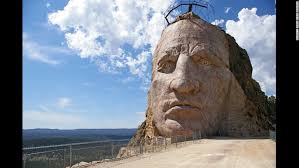
CRAZY HORSE Memorial


One of the monuments that caught my imagination is  "Crazy Horse Memorial" near Rapid City, SD, USA. The memorial is being carved in the Black Hills of South Dakota, about four miles from " Custer National Park". It is necessary to know about "Crazy Horse" himself before dwelling on the monument being carved in his honour. 

Crazy Horse is the name of an American Indian leader. His actual name is not known but he is referred everywhere as Crazy Horse. (In America, native Indians are called "Indians". We, Indians from Asia are called as "East Indians"). He was born in 1842 (his date of birth is not recorded) but he lived for only 35 years and was killed on 6th September 1877. He belonged to the Lakota tribe of the Indians, but today he represents all the tribes and a hero to all of them. The memorial, therefore, represents North American Indians of all tribes. He cared for the elderly, the sick, the widowed and the children. He strived for preserving the values and culture of Indians. He never signed a treaty or touched a pen in his life. His tenacity of purpose, modest life style, unfailing courage and his tragic death set him apart and above all other leaders of his tribe. On 6th September 1877, while at Fort Robinson in Nebraska under a flag of truce, he was stabbed in the back by an American soldier.

In reply to a derisive question by a white man "Where are your lands now?" he is reported to have stretched his left hand pointing to far away lands and replied: "My lands are where my dead are buried".

Lakota tribe chiefs decided to carve a monument in honour of such a leader in the Black Hill range, considered as sacred by the tribe. The idea took shape in the early thirties and was a desire of the Indians to show the world and the white man that they also have heroes. It may be recalled that the carving of American Presidents in nearby Mount Rushmore was started in 1927. Lakota chiefs approached a sculptor of Polish origin named Korczak Ziolkowski. Korczack was working as an assistant to Gutzon Borglum in Mount Rushmore. Korczack selected the site for the monument and the land was purchased in the name of  "Crazy Horse Memorial Foundation". The foundation has not accepted any Federal or State funding and the work is being carried on only on the contribution of the general public and proceeds from the memorial entrance fee and gift shop. The Foundation has also planned a Large Museum of North America Native Indian Culture.

Some facts about the memorial give an insight into its gigantic proportions. The memorial is in the form of Crazy Horse sitting on his horse in a riding pose and his left arm and forefinger pointing to his lands – remember his saying:  "My lands are where my dead are buried".  Upon completion the memorial will be 563 feet high and 641 feet long; it will be the largest statue in the world. Completed head of Crazy Horse is 87 feet high or equal to a 9 story building. Horse on which he is sitting has a head of 219 feet or equal to a 22 story building. The head of Statue of Liberty in New York is 19 feet high.  The full  length of George Washington would have been 465 feet if it had been carved in the Rushmore memorial. More than ten million tons of rock has been removed from the hill so far.

Korzack Ziolovski was born on 6th September 1908 and it is a coincidence that crazy Horse was killed on 6 th September 1877.  Korzack started the work when he was 39 years old and died when he was 74 years old, on 20.10.1982. He worked on the memorial for 34 years.  He married Ruth and the couple had 10 children, 5 boys and 5 girls. At one stage Korzack even started his own school to teach his children and children from nearby areas!   When he died he told his wife- "You must work on the mountain; but go slowly so that you do it right".  Today the work is carried on by his wife Ruth and seven of their ten children are also working on the monument. Recently their grand children have also joined them making them the third generation working on the memorial. The project is already 62 years old; work is still progressing and may take many more years to complete. Progress is slow but work always going on.The memorial is three dimensional and hence the work is involved is greater.

When the monument is completed, the following poem written by Korzack will be carved below the monument in letters three feet high so that the same can be read from a distance:

When the course of history has been told, Let these truths here carved be known:

Conscience dictates Civilizations live
and duty ours to place before the world
A chronicle which will long endure.
For like all things under us and beyond
Inevitably we must pass into oblivion.

This land of refuge to the Stranger
Was ours for countless Eons before:
Civilizations Majestic and Mighty.
Our gifts were many which we shared
and gratitude for them was known.
But later, given mu oppressed ones
Were murder, rape and sanguine war.

Looking east when invaders came,  Greedy usurpers of our heritage.

For us the past is in our hearts,  The future never to be fulfilled.

To you I give this Granite Epic, for your descendants to always know -

"MY LANDS ARE WHERE MY DEAD LIE BURIED."

Thousands of tourists visit the memorial daily though the memorial is not yet complete.  Korzack's plaster of paris model, his tools and other collections are displayed in a museum at the visitor's center near the memorial. The memorial trust plans to start a North American Indian cultural center and a library. The outdoor multimedia program projects photos and animation on the 500-foot-high mountain side. 

Crazy Horse was never photographed and his picture is not available.  The monument is being carved on the basis of the description given by his contemporary Lakota chiefs. As Korzack said, the monument is more a depiction of Crazy Horse's spirit and represents American Indians of all tribes. The monument stands as much a testimonial to the values for which Crazy Horse stood as the vision of Korzack and dedication and efforts of Korzack-Ruth and their family.

Our visit to the Crazy Horse Memorial stated with a video presentation on the making of the monument in the theatre at the visitor's center in the memorial. After viewing the monument from the platform at the memorial, we had a round of the gift shop where many items of American Indian culture and history are displayed and available for sale. We also visited the sculptor's house where the model used by Korzack and tools etc. are displayed. Pictures of the memorial at different stages of creation are displayed indicating the progress in carving from time to time. 

Crazy Horse memorial is a must visit place for anyone going near South Dakota, just like the Mount Rushmore on which the heads of USA's four past Presidents is carved.

Monday, December 5, 2011

Mother's SEVEN Golden Rules

Last week I met an elderly friend and well-wisher, after a gap of five years.   We talked about many thing and many other common friends.   He is a man who achieved many distinctions in his professional career amidst adverse and critical conditions.  Among his many achievements was a successful fight for getting a degree of respectability for people working with him and recognition from a tough management.  What struck me most was his eagerly looking forward to an urgent trip next month to his native place.   The journey would be quite long with more than twenty hours flying and ten hours thereafter by road, but he was looking forward to it with a great deal of enthusiasm.  "My Mother is there in my native town.  I have to touch her feet and seek her blessings",  he said with a boyish smile.  He is himself 75 years old and grandfather to three or four grandchildren.  How lucky a man, I wondered.  

Most people agree that to have parents with them for a long time is a big boon.  Very few may have some reservations on this.    Some unfortunate ones do not even remember the faces of their father or mother due to losing them at a tender age.  Some are fortunate to live with them during early years.  Very few have their parents alive till their own advanced age, like this lucky friend.   This incident brought up memories of my own mother.   I was also lucky enough to have our mother with us till I was forty years old.   Half of this period was spent in her direct care.  She herself lost her father when she was only seven years old.  Her two elder sisters were already married by that time and she was brought up by her widowed mother, along with her two younger brothers, during the difficult days of recession and drought.  Being from a village she could study only up to fourth standard and could read and write our mother tongue, Kannada.  She was initiated into taking care of young kids when she was herself a child, by being motherly to her two younger brothers.  Married very early, she took care of eight of us and led us along our lives in a way we cherish the upbringing.

Among the many lessons we learnt  from her was that formal education and knowledge were two different things.   She studied only up to fourth standard but was no less knowledgeable than people with college degrees.  She was well versed with our culture and had a through knowledge of our epics and stories.  She had a very rich voice and could sing for hours together.  She had a song to sing on every occasion, be it marriage or housewarming or naming ceremony or some other function.  Her singing would start with sunrise and continue with her daily chores side by side.  She had a different set of songs for each day of the week and song from any set was not repeated till the next week day.  Afternoons were reserved for reading from some books or singing from some epics.  She did not need a book or a pen but when she wrote letters, it was with a legible and neat handwriting.   She was available to her neighbors with a helping hand at all times of need.  Like most mothers, she had abundant patience but could be stern and tough when the the need arose.   She ran the family admirably during the critical years during World War II when my father was with the army and away in Burma.  

She had a set of rules to be followed at home.  They were golden rules. The rules were based on sound economic and moral principles.   No pressure or force was required to enforce them; they were automatically complied since they were fair and square.  First rule was that the use of bathroom and facilities at home should be regulated in accordance with the timings of persons going out for office or school.  Early goers get to use them first.  This way every one would have enough time to get ready and be on their way.  If some one still wanted early use, he should get up early and finish his requirements before others.  There could be exceptions but the general rule should be followed.  With a dozen persons at home, this was the easiest way to avoid friction and ensure fair treatment to all. 

Second rule was about serving food and drinks.  Food should be consumed when it is prepared and ready.   If anybody wants to take bath and say prayers before breakfast, it should be done before being called upon to take breakfast.  Kitchen head had to serve many persons and statements like "I have not yet taken bath or I will have it later" were not acceptable.

Third rule was about complaint about items prepared.  When there are so many people around and many items prepared, one may like some and may not like some others.  "Eat two spoons more of what you like and two spoons less of what you do not like", she would say.  It is difficult for a kitchen head to procure various items required, prepare the items and serve so many people.  Availability of items depends on seasonality also.  The difficult task of the person running the kitchen should not be rendered even more difficult by wild behavior and complaints.  Of course, with the variety of items she would provide there could be no complaints about quality or quantity.   Never.

Fourth rule was about the order of consumption.   Those were the days of  "No electricity and no refrigerators".  Monsoon months would be difficult as supply of items were disrupted for days together.  Items like Pickles and pappad were generally reserved for the tough monsoon months.   On regular days they should be resorted to only when other items were not available.  There was no point in wasting pickles or pappad when three or four other items are available.  "What will you do when it is raining continuously and vegetables and curds are not available?", she would ask.  If some one asked for them on a regular day, he or she would still get it.  But the rule will be reminded gently.

Fifth rule was about having breakfast, lunch or supper together.  As far as possible, all persons present at home should have food together.   This would render kitchen management easier and provide some rest for the kitchen incharge.  If the item being served is like Dosa or Rotti, made one at a time, the youngest will eat first followed by others in that order.  Exchange of order of serving by mutual consent was permitted, but the preparation should go uninterrupted.  There were no "switch on - switch off" stoves in those days and cooking was on firewood ovens.

Sixth rule was to be followed when visiting a relative or friend.  The items served there may not be to our liking.  But complaints should not be made.   "We do not know what constraints they had.  We should not embarrass them.   If you do not like something, eat it like medicine and manage",  she would say.

Seventh rule was about appropriation of resources in the family to match the needs of all family members.   Resources will be applied to meet the needs of the person whose need is the most and urgent.  Others will follow in the order of urgency of needs.  Or resources will be shared if all the needs are equal.  Needs of the younger and sick would override those of other members in the family.   She did not have any needs for herself.

Then there was a philosophy of life, which was somewhat universal.  "We should not trouble others.  We should not be troubled by others.  We should not be troubled by ourselves as well!"

All mothers may have had similar rules.   That is how they were able to manage large families over the years with limited resources and saw us through difficult times.   

Saturday, December 3, 2011

Ten uses of a Danda (stick)


Some sixty years ago, we, a group of six or seven boys were playing with a tennis ball, outside our uncle's house. The ball was hurled with full force by one of the boys and it sneaked through the open window of the house and hit an elderly visitor (our uncle's uncle) sitting inside the house and talking to our uncle. Uncle got hold of the ball and shouted at us, "Bring that stick here. I will beat each one of them. दण्डं दशगुणं भवेत् (Dandam Dashagunam Bhavet)".


We were interested in retrieving the ball and continue with our game, but none wanted to be seen by the uncle for the fear of getting beaten. We were watching behind the door as to where he would keep the ball after his temper cooled down. The elderly visitor was in some pain and discomfort due to the unexpected and sudden hit by the ball. But he brushed it aside and questioned our uncle who was much younger to him. "What do you mean by "Dandam Dashagunam Bhavet?", he asked. We were amused to see somebody asking us questions all the time being himself questioned by someone else. "Forget about beating us uncle, answer the question now", I thought of telling my uncle, but was not bold enough. "What is so special about it? It means you get ten times the result by beating with a stick or handing out strict punishment in a broader sense", was the uncle's answer. "Understand things properly, you fool!", the elderly visitor thundered. The uncle's answer was correct, I thought, for that was how this idiom was always used. But why was the granduncle angry?


"You are aware words have many meanings?" asked the granduncle. "Yes, we all know that" answered the uncle. "You are aware that the word Hari has as many as sixteen meanings including Lord Vishnu, horse and monkey?"  "Yes, I know" replied the uncle. "What is the meaning of  'Staff' in English?" was the next question by granduncle. "It means  'a group of employees, charged with carrying out the work of an establishment or undertaking",  the uncle said. "What do you call a pole on which a flag is hoisted?" asked the granduncle. "That is a flag staff", said the uncle. "Then what is another meaning of staff?" was the next question.  "A stick with some special use, such as a walking stick. An emblem of authority in the hands of a King or religious leaders is also called a staff", replied the uncle. We did not understand the full import of the exchange, but our uncle probably understood that the granduncle had something to say on the issue. "What is it you want to tell me, uncle?" asked our uncle,  his anger gone and humbler now.

"I always see people using  "दण्डं दशगुणं भवेत्" in the same context you used. "Danda" has many meanings. One of them is Punishment. Another meaning is a stick. Monetary penalty is also called Danda. "Dandam Dashagunam Bhavet" does not mean beating is ten times effective. Here Danda is not used in that context. What is "Dwiguna" or "Triguna"? It means twice and thrice. Just like that "Dandam Dashagunam Bhavet" means a stick has 10 different uses" said the granduncle. He continued : "People have forgotten three fourth of the sloka (verse) and are using the last quarter giving a wrong meaning!". He recited the full sloka :

" विश्वामित्रेच  वार्धक्ये  रात्रौ अप्सु कर्दमे  |  अन्धे सर्पेच क्रीडेच दण्डं दशौनं भवेत् "

"Viswaamitrecha vaardhakye raatrou apsu kardame, andhe sarpecha kreedecha dandam dashagunam bhavet"

"What  Rishi (sage)  Viswamitra  has to do with it, maama?", asked our uncle. "It is not sage Viswamitra.  In fact it is this word that is the key to the ten uses. Unless you decipher it, you will not get the proper meaning. It is a combination of  Vi, Swa and Amitra. Vi stands for Vihaga or bird.  Swa means Swaana or Dog. Mitra has two meanings. When used in masculine gender it means the Sun. Otherwise it means friend.  Amitra means not a friend or an enemy.  Now you tell me the ten uses of a Danda or a stick", invited the granduncle.  Uncle was now able to elucidate clearly on the ten uses of a stick.

First use is to repulse an attack by a Bird. Bird attacks are common in villages, especially when you are carrying some corn or fish etc. Second use is to threaten and protect against Dogs. Third is to use it as a weapon against an enemy attack. Fourth use is as a support stick in Vardhakya or old age. Fifth use is in raatri or nights, as a handy weapon while walking in the darkness.  Noise made by beating on the ground with the stick makes others aware of a moving person and also drives animals away.  Sixth use is in Apsu meaning water.  When crossing a river or stream a stick is used as a means of finding out the depth of water at every step. Seventh use is in kardame or while negotiating a swamp or quicksand. Eighth use is by the blind as a support.  Ninth use is while dealing with sarpa or snakes. Tenth use is in kreeda or sports and games.

Sticks are used in many games. Hockey, Cricket (stumps), Snooker, golf are some examples. Villagers use sticks for many games. Sticks are also used for supporting plants, especially creepers and in agriculture activities like growing tomatoes and similar vegetables.

Like many other idioms, Dandam Dashagunam Bhavet is also used in the different context.   But it has come to be so widely accepted that everyone believes that it is the right use!  Thanks to the granduncle, we realised this. I am trying to recollect the quoted verse after fifty years. I have searched for the original texts but did not find any source. If you search Internet you will only find references to some movies with this name. 

Villagers say "this well belongs to ten people". Does it mean it belongs to  9+1 or 8+2 people? "Let hundred people say hundred things, I don't care", is another common usage. Does it mean 99+1 or 101-1 here? Take "Purusha Sookta" for example. It says, Sahasra Sheersha Purushaha, Sahasrakshaha....". It means the Virat Purusha has 1000 heads and 1000 eyes. Is it a number of heads with one eye per head? It looks absurd. The real meaning for these words like ten, hundred and and thousand are "many". When it said that the well belongs to ten people, it means that it belongs to many people. In case of Purusha Sookta, Sahasra is not thousand; it is infinite! The Virat Purusha has infinite heads and infinite eyes! How logical and sensible!

The four types dealing with or resolving issues -  chaturopayas ( चतुरोपाय ) as they are called and attributed to Chaanakya or Koutilya  (it should also be Koutalya and not Koutilya as the name is derived from his Gotra, the one born in Kutila Gotra is called Koutalya) are साम, दान, भेद, दण्ड (Saama, Daana Bheda and Danda and translated into English as Persuation, Temptation, Separation and Subjugation) and in this context Danda means punishment.  May be one of the punishments may be given using a stick!

Saint Thyagaraja in his famous Kaapi Naarayani Raaga composition "Sarasa Saama Daana Bheda Danda Chatura"  says that Lord SriRama was a past master in the art of using all these methods. In fact he has added one more method i.e.  सरस (Sarasa) meaning extreme persuasion like the one used by a wife or husband while dealing with the other spouse (Kaantasammita). Some say this is included in Persuation itself.  No stick is used in this method, for sure!

Friday, December 2, 2011

200 Bags of Groundnut Oilcake

There is a general impression that Banking is carried on in Bank premises.  This is an impression not only with the general public, but also among bankers themselves.  What is done within the four walls of a bank branch is mainly Accounting and very little of actual banking.   Banking is mostly in outdoors and that is where the real action is.  Practical Banking is actually in Agricultural fields, factories manufacturing various products, markets and bazaars.   A banker who loses touch with the outside world will be put to lot of difficulties.  An arm chair banker is no banker and without constant touch with realities of happenings outside his four walls, he is a lame duck and an easy prey.

One of the first lessons I learnt in Banking was through 200 bags of groundnut oil cakes.

This was nearly four decades ago.  I had just started working in a bank branch at a place well known for agriculture produce.  Cotton, ground nuts, pulses, jowar (a type of corn), chillies were the main crops grown in the area and there was a big trading market as well in that place.  The major customers of the branch were traders in these commodities.  Just as mobilization of resources in the form of deposits is important for banks, profitable deployment of such resources by lending to all sectors of the economy is also equally important.   Traders are an integral segment of market economy and this branch was known for lending to traders in these commodities.   Many of the traders were in this line for generations and enjoyed excellent reputation in the market.

During the 1960s and 1970s, there was a severe strain on the resources and lending was subjected to several restrictions and strict supervision by the Reserve Bank of India.   Guidelines famously known as "Selective Credit Control" and "Credit Squeeze" were in force and lending to trading sector was specially marked for additional controls to curb hoarding.  In order to reduce availability of funds to traders, margins were increased suddenly, thus bringing down the drawing limits (Please read blog:   http://roundtheclockstories.blogspot.com/2011/11/haircuts-and-stock-markets.html  for effect of margins on borrowing) even though traders were able to provide adequate physical securities and stocks as security.  In short, traders were finding it difficult to raise funds despite having sufficient stocks.

There was another difficulty for the traders.  Sanctions of borrowing limits to them (and also other sectors) were in many forms, main types being Cash Credit  (popularly called as "Overdraft") and Discounting of Bills. Limits against discounting of bills were further divided as against clean bills and documentary bills.  Clean bills discounting limits were without any security backing and such limits were very frugal and almost negligible in relation to the volume of business of the trader.  Documentary bills limits were relatively better as they had the security of documents of title to goods in transit; general examples being Railway Receipts and Motor Transport Receipts (RRs and MTRs).  Limits against RRs were sanctioned relatively more liberally as against MTRs on the reliability factor.  In case of default by the party, banks could take delivery of the goods sent by Railway wagons or Lorries and realize the lent money by selling the goods.

There were some reporting requirements by banks to RBI for monitoring purposes.  One of the statements was called Form-C, in which details of loan outstanding against different commodities, classified as sensitive commodities, was to be reported periodically.  Entire working in those days was manual and not even electronic calculators were available.  All of us were provided with a book called "Kapoor's Calculator",  using which interest chargeable was manually calculated and checked.   Any wrong calculation would result in loss of income to the bank and audit objections on these issues were dealt severely.

One of the well know traders in the locality was sanctioned  big borrowing limits for his trade in my branch.   The limits were adequately secured by mortgage of shop and big open area attached to it where large quantities of commodities were stocked.  The party was financially sound and was quite solvent.  Each day some bills would be given for discounting and the funds thereof would be used for further buying the commodities.  I had just joined the bank and put on the seat for discounting of bills.  Arrival of the party's representative at the branch meant more work for me as he would bring bundle of bills for discounting.  A senior official who was preparing the statements of disclosures to RBI taught me how to handle the work. It basically consisted of entering the details, accounting the bill amount, calculating the interest and discount charges, sending the bills to another branch for presenting to the buyer for recovering the money and also accounting the payments properly when received.  One of the things he specifically told me was to note the item dispatched against which the bill was drawn in the last column of the register.  The description of item consigned would be available in the RR or MTR, usually with words like "200 bags said to contain groundnut seeds" etc. The disclosure statements would be prepared by aggregating such entries at the end of the month.

During the first month of my working the party had produced several bills covering consignments of several commodities like Groundnuts, Groundnut seeds, Groundnut oil cakes and grains like rice and jowar.  I had noted the consignment items dutifully in the last column.  At the end of the month, the senior official advised me to total the amounts item-wise to enable him to classify in the reporting statement.  I complied with the advice and found something amiss in the case of Groundnut oil cakes.  While all consignments were for 200 bags of oil cakes, the amount of bills in rupees was 17,000 initially and had gone up to 34,000 during the middle of the month and was as high as 45,000 at the end of the month.  I mentioned this aloud while handing over the summary of the month's bills.  There was sudden activity in the branch and the matter was reported to the Branch Manager.  Branch Manager called for the entire records and after scrutiny telephoned the party's office and called the representative to the Bank.  There were some discussion on the issue.  In the course of next two weeks all these bills were paid  and thereafter the branch stopped accepting bills covering dispatch of oil cake consignments for discounting.

Oil cake is a mass of seed from which oil has been extracted or expressed, and is used as feed for livestock.  In India nearly half of the area for cultivation of oil seeds was covered by groundnut and the nuts have as much as 40% oil content.  Groundnut is a native of South American Countries, mainly Brazil, Peru and Argentina.  It is said to have been introduced to India in the 16th century from one of the Pacific islands after traveling from South America.  Since most of the oils now used in cooking is hydrogenated oils, we are  denied the pleasure of  the taste and aroma of items cooked in oils like groundnut oil, til oil, coconut oil etc.  Sesame oil alone appears to be used in original form in some parts of the country.

The actual value of  200 bags of oil cake was much less than shown in the bills given to the bank.  As and when the credit availability became tight and margin was increased on stocks at the godowns, the party increased the value in the bills and started obtaining higher level of funds against oil cake bills.  There was an understanding between the buyer and seller and the bills would be paid by the buyer for full amount after getting the difference amount from the seller through telegraphic transfers.  Such bills are called as "Accommodation Bills" in banking language and in case the party fails to pay the bills, banks are exposed to loss as the value of goods will be much less than the funds advanced against them.  In those days banks were maintaining  a register called "Daily Rate Register" in which market rates of various commodities were noted on daily basis to enable the branch to keep track of price movements and safeguard bank's interests.  As groundnut oil cakes were not being advanced against except as bills, the rates were not monitored.  Party took advantage of this loophole and drew additional funds from the bank through such bills.  Today such register is not required as a visit to krushimaratavahini.kar.nic.in will give daily rates for all agricultural commodities in Karnataka and similar websites are available for other areas as well.

After about one year I was transferred from that branch.  On the day of my leaving the branch, this party's representative, who came to the branch daily for the firm's banking work, requested me to join him for lunch.  When I declined due to last minute arrangements and winding up, he insisted to have dinner before boarding the bus in the night.  While having dinner he thanked me for the favour to him.  I did not understand what he had in mind.  When I asked him what was the favour, he told me that he was opposed to getting the oil cake bills discounted for higher value but his mota seth (head of the firm) directed him to follow instructions.  Due to my pointing out the discrepancy bank stopped accepting such bills and he and the firm were spared of further embarrassment and loss of reputation.  How long this practice was going on and whether experienced people in the branch were not aware of it,  was a question I never asked.