Tuesday, April 30, 2013

The Drunkard's Daughter

The years spent in Middle School (5th to 7th year of education) were indeed wonderful days. General economic conditions in the early 1960s were difficult.  Aftereffects of Indo-China war of 1962 and Indo-Pakistan  war of 1965 had added to the misery.  As students, in the age group of  11 years to 14 years for most of us, we were hardly in a position to understand that.  We lived in our own world and school days were merry days and playful as usual.  Lunch break at 1.30 PM was eagerly looked forward to by all my classmates and I was no exception.  Students coming from nearby houses would run home to have a quick lunch and return to school for post-lunch classes.  Those staying away from the school had to perforce stay in the school compound and eat lunch from the boxes brought with them in the morning while coming to school.  Of course, there were many who did not have the luxury and practice of having lunch.  They were used to food only twice a day; before coming to the school in the morning and in the evening after returning from the school.  This had its own advantage; they never suffered from indigestion and related ailments.

For the children staying back in the school compound during lunch time, there were other activities.  Playing cricket or football was one of them.  There was no practice of giving pocket money to children in those days mainly because the pockets of the parents themselves did not have any money in them.  There were a few kids from relatively affluent families who carried small change in their pockets.  They had  attractions just outside the school gate abutting the main road of the town.  Two carts carrying items for sale beckoned them.  One of them carried groundnuts and uppukadale (salted chana) and the other laden with cut fruits available in the season.  Uppukadale and Groundnuts were acceptable, but we had strict instructions not to touch the cut fruits.  The threat of cholera was always lurking round the corner.  My mother's advice was soft and firm.  If any child in the family is tempted to eat any fruit sold on the cart, she should be informed.  She would arrange for getting the item and serve it at home in hygienic conditions.  If the instructions were violated and someone fell sick, she would not take care of them.  The threat was enough and there was no need to test her resolve.  We understood her perfectly and she ensured that the instructions were always complied with.

The cart with cut fruits was tended by one Hanuma.  He would procure the seasonal fruits like Guava, Mango, Jack fruit, Papaya and Watermelon.  Pineapple and Apple were also seen but rarely.  Mother's instructions were not to touch them; there was no ban on watching him clean and cut the fruits.  He was an expert in his trade and probably worth an award these days when everything is measured and awards given away.  He had his tools - knives of different sizes and shapes to handle the variety of fruits ranging from the hard and thorny jack fruit to the softer fully ripe papaya.  Processing activity of cutting and arranging the fruit pieces went on simultaneously with the sales activity of handing over the cut pieces to children, collect coins, count them and store them below the gunny bag table cloth.  He did brisk business during the lunch break and moved away to the nearby bus stand once the children got into their classes.

Hanuma was a hard working man and was always involved in some work or the other.  He had a small plot of land by the river side and grew vegetables there round the year.  After harvesting them for the day's sale he would proceed with other errands like sale of cut fruits.  His wife Ramakka carried the vegetables basket on her head selling them from house to house in the morning.  The quality and freshness of the vegetables ensured that there was no carry over of inventory for the next day.  Between them they earned a decent wage.  But the one weakness of Hanuma ensured that the family always lived in abject poverty.  Drunkard and inebriate are terms for a person who drinks hard liquors habitually. Drunkard connotes willful indulgence to excess. Inebriate is a slightly more formal term than drunkard.  Dipsomaniac is the term for a person who, because of some psychological or physiological illness, has an irresistible craving for liquor. The dipsomaniac is popularly called an alcoholic.  Hanuma was probably all of them.  He loved his family but it appeared he loved his evening drink even more.

Ramakka suffered silently and somehow managed the family affairs.  All her efforts to bring round Hanuma failed.  One evening she appeared before our house and wanted to see my father.  He had just returned from school and took his usual place in the front yard.  Their conversation went on like this:

"Swami, Hanuma's drinking is killing us.  Why don't you help me?"
"How can I help you, Ramakka?"
"Hanuma respects you a lot. Please advise him to give up drinking."
"I have advised him many times.  Every time I talk to him, he promises not to drink again.  But he does not stick to his promise.  His friends are not good.  He also cannot resist the evening drink."
"Then what is the way out for me?"
"We have to keep trying and hope for the best.  By the way, who is that girl hiding behind you?"
"This is our daughter Saraswati, Swami."
"How old is she?" 
"She is six years old, Swami."
"Have you admitted her to school? All children at this age should attend school."
"What will she do with school, Swami?  She helps me with household work and selling vegetables.  That is fine with me.  Hanuma also wants the same."
"Do not talk nonsense.  Do not spoil her life.  Bring her to school tomorrow.  I am the headmaster.  I will admit her to the school.  Ask Hanuma to meet me in the morning."

Hanuma duly arrived in the morning.  The discussion went on like this:

"Swami, It seems you wanted to see me."
"Yes, Why have you not put Saraswati in school?"
"What is the use of school for us poor people, Swami.  Moreover I cannot pay school fee."
"No need to pay any fee.  I will get her fee waived by the Government.  I will get her free uniform from Headmaster's quota.  I will also arrange for books from some other students who are promoted to the next class.  You have no excuse.  She should be in school by the time I reach there."
"Swami, should I really do it?"
"Yes, otherwise I will get you arrested by the police for violating government order."

Hanuma was afraid of government and police.  He did not even think of checking with someone.  He complied with father's orders.  Saraswati was admitted to first standard at school.  She was better than average in studies.  She passed her examinations every year.  By the time she came to High School, I had left the town and was working in a far away city.  On one of my home visits I learnt that father had arranged for her learning typewriting and shorthand in the local "Institute of Commerce". The Institute head was persuaded to give her a slot in the early morning class when the attendance at the institute was thin.  No need to mention that the fee was waived by him.

The last I heard of Saraswati was that she had secured a job as a Stenographer in the State Government and working in a building near Vidhana Soudha (State Secretariat). That was thirty years ago.

Sunday, April 21, 2013

Post Cards and "England Letters"

A post card was the most popular medium of communication between two places in the country some five or six decades ago.  An area of about 20 square inches on one side and half of it on the other side was for messages.  The remaining one fourth was reserved for writing the address for delivery by the post man at the destination.  If more space was required for writing the message, one could use the "England Letter".  Its actual name was and is "Inland letter", but it was referred to popularly as the "England Letter", especially in the rural areas.  One reason probably was because the England bosses ruled the country for a long time and the other was due to the two words sounding similar.  The third brother of the family, envelope, was considered expensive and reserved for official communications and rare occasions when sheets of paper were used for writing or to enclose some document etc.  There was a fourth brother of the family available for sale at larger post offices; special envelopes for carrying letters abroad, popularly known as "Foreign letters".  All of them are still in use, but have been replaced to a large extent by electronic communication medium like e-mails.

As a young boy I was fascinated to find that such cards and letters reached the addressee in a distant place.  Whenever the post man came to our street, we children would go behind him till the end of the street to find out which houses received letters that day.  One other thing that pleased us most was when the post man brought money orders.  My mother received two money orders (MO) every year; her two younger brothers always sent a M. O. to her a week before the Gowri-Ganesha festival.  The message part of the MO given to her with the money by the post man contained the usual request for utilizing the money for purchasing pooja items for the festivals.  The earliest MO amount as I remember were five rupees and increased to ten rupees in due course.  This sending and receiving of MO, however small the amounts were, was given high importance by both the senders and receivers and was a symbol of the bond between brothers and sisters.  One of our neighbors was working in a far away city and his wife would wait for the arrival of the post man in the first week of the month, bringing the MO sent by her husband for household expenses.  The post man would come promptly and deliver the money.  She used to keep a four Anna coin (quarter of a rupee) ready and gave it to him after receiving the money.  For quite some time I believed that it was part of the postal procedure.  It was much later that I learnt that this coin was actually a tip and it meant "To Impart Prompt Service"!

Those were the days of very low literacy and many villagers used to come to see my father and seek his help in writing letters for them.  My father would purchase postal stationery during his visits to the nearest big town and keep a stock of post cards, inland letters and envelopes to meet the requirement of the villagers.  Sunday mornings were busy times with many illiterate people from nearby villages coming for getting their letters written by him.  Some of them brought inward letters (letters received by them) and ask him to read them over.  Then the reply was to be decided and written by him.  As the letter for one villager was being written, others would sit below the tree in the front yard and patiently wait for their turn.  The process of writing a letter would start with inquiry about the addressee and contents of the message to be written.  There was no particular order in their answers and it was left to him to bring it into an acceptable form of communication.  He would write the letters, read them over to them and then mail them.

Whenever my father sat down near his small desk for writing cards or letters, I would take my place next to him and keenly observe how he went about it.  When I was in primary school, I was not allowed to touch any of those things; the desk, cards and envelopes or the pens.  As I moved to middle school, I was permitted to help him with placing the desk in its place, filling the pen with ink, pasting the inland letters with gum and finally going up to the post box to mail those cards and letters.  When I was sent to post the letters for the first time I was told to put the letters in the box and salute the post box so that the letters were delivered promptly.  I did this faithfully for sometime until I realized that the instructions were in jest.  During my first year at High School I was assigned to write the letters for the villagers under his watchful eye.  He would then scrutinize them and approve their mailing.  Once he was satisfied that I could do a good job of it, he delegated all the writing to me.  Literacy level improved by that time and the number of villagers coming for such errands also declined.

My father always wrote the address on the cards and inland letters first and thereafter went about inking the messages on them.  After observing this system, once I asked him why he did so.  In response to my question, he told me a fine story.

Those were the days of early marriages.  One village boy was married immediately after he finished his metric examination.  He was about sixteen years of age and his wife was studying in middle school.  He was sent to a city for pursuing his college education.  His father had instructed him to write a letter every week to inform the progress in his studies.  He had to comply with the instructions of his father.  The boy himself wanted to write to his young wife.  (He was probably reading "Mysooru Mallige" of the famous poet K S Narasimha Swamy!).  He bought two inland letters from the post office and wrote to his father as well as his wife.  The contents of letter to father conveyed that he was fully concentrating on his studies and his mind was occupied by only this and nothing else.  The letter to his wife had the opposite message: he was always thinking of her and had no interest in the studies.  He even expressed annoyance with the father for not allowing him to stay with the newly wed wife and forcing to go away to a distant place for studies.  Both the letters were fine in their own place.

He had no habit of writing the addresses on the inland letters before writing the contents.  The letters were sealed with gum before the address part was completed.  While writing the addresses on the two inland letters, he wrote the address of his father on the letter written for his wife.  The letter meant for his father was mailed with his wife's address on it!      
       

Saturday, March 16, 2013

Calamity or Opportunity?


In a post titled "From Post cards to Chappatis"  I had mentioned about how marketing opportunities are en-cashed by the wizards who lead by examples. Another such stalwart who is a role model for budding entrepreneurs was one who converted calamities like epidemics and wars into business opportunities to give a thrust to his marketing forays and built a business empire of his own.

A calamity is defined as a great misfortune or disaster, especially one that causes extreme havoc, distress or misery. Epidemics in the form of dreaded diseases like Plague and Cholera have consumed millions of lives in the early part of 20th century.  Wars are no less severe in bringing such distress and pain. Opportunity is defined as an appropriate or favourable time or occasion for an attainment of a goal. Is it possible to convert such epidemics and wars into an opportunity? Rai Bahadur Mohan Singh Oberoi has showed that calamities of epidemics like Plague and Cholera as well as wars can be converted into opportunities, with foresight and hard work. Acting smartly during such adverse times, from a penniless hotel clerk he rose to become a pioneer in luxury hotel industry. His life story makes an excellent case study for students of marketing. It is true that every salesman who reads his case cannot become another Oberoi. But the case can motivate them to think out of the box and see an opportunity even in calamities.

Mohan Singh Oberoi
was born on 15th August 1898 in village Bhaun, near Rawalpindi, in the undivided Punjab.  He used to mention his birth year as 1900, two years later, and it was believed that this was because he did not want to be seen as dating from 19th century. He could study only up to Matriculation due to family financial constraints and worked in a shoe factory as a supervisor. The factory too closed down due to losses but taught him to always wear shining shoes. He was forced to move out of his village due to the deadly Plague that hit Punjab and killed thousands. Recently married, he moved with his wife to Shimla. He chose Shimla because it was the summer capital of the Britishers who were ruling the country. His knowledge of typing and shorthand skills and well-knotted tie and shining shoes got him a job in Cecil Hotel in Shimla. Some years later when his boss wanted to sell the Hotel, by then known as Clarkes Hotel, he mortgaged his wife's jewellery to buy his first hotel. From then he went on adding more hotels and at his death  his empire comprised of 35 hotels spread over India, Sri Lanka, Nepal, Egypt, Australia and Hungary.

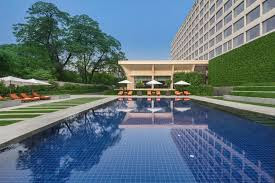
Calcutta's famous "Grand Hotel" was closed down in the aftermath of the Cholera epidemic in 1933. More than a hundred foreign guests died in the outbreak of the disease. The hotel remained closed for five years due to fear of the epidemic lying latent in its water supply system. M S Oberoi found an opportunity here and took lease of the hotel by raising funds from relatives and friends. When hotel owners talked of Goodwill, he silenced them by arguing that he be paid compensation as the place only carried Ill-will and not Goodwill due to its history of deaths due to Cholera! He got the entire water supply system thoroughly cleaned and yet guests were unwilling to arrive. He promised incentives like cheap or free boarding facility to attract customers. 

By that time Second World War had started and Calcutta was the pooling place for troops to fight on the eastern borders. The government had the authority to acquire any building for war purposes. He apprehended  that the hotel could be a potential target. He improvised 1200 beds at the hotel and approached the authorities with an offer to provide accommodation for the soldiers at rupees ten per soldier per day. The offer suited the war managers as they were free of the botheration of managing rations and food supply. The losses in room rents were made up by charging extra for other facilities provided to the soldiers. This ensured full occupancy of the hotel during the war period as well as avoiding losing control of the hotel. British Government honoured him with the title "Rai Bahadur" in 1941. In 1943, he started to secretly buy the shares of Associated Hotels of India Ltd. They were the days of  "Share Certificates" (Demat was not yet born) and he walked into the Annual General Meeting  of that company with canvas bags full of share certificates and presented them to directors. Controlling interest passed into his hands from Spencer & Co and his hotel chain expanded further. 

M S Oberoi is also credited with bringing many changes in the hotel industry and providing comfort to his guests at the hotels. His introduction of chambermaids in 1957 with vacuum cleaners in their hands raised a furore and was debated even in Parliament. Probably this led him to try his luck as a parliamentarian and he won a seat in the Rajya Sabha 1n 1962. He won an election to become a member of the Lok Sabha in 1967 and returned to Rajya Sabha in 1972. He lost four Hotels in Pakistan during the 1965 war, but raised money in Saudi Arabia to invest abroad in new hotels. He chose this route due to tight money controls in force in India then. His partnership with Inter-continental group in 1965 started the Oberoi Intercontinental. From then on, he specialised in spotting and refurbishing run down and undervalued properties and expand his hotel chain. His service to the industry was recognised by his peers by making him as the President of Hotel and Restaurants Federation of India. He was awarded Padma Bushan in 2002.

He believed that "too often efficiency and high standards once established are taken for granted" and hence made personal checks of how his hotels were run.  Called "Conrad Hilton of India", his belief in business is summed up in his statement "You think of money and you cannot do the right thing.  But money will always come when you do the right thing". He lived a full life and died on 3rd May 2002, at age 103. Even by his admission of year of birth as 1900, he lived for 101 years and was active throughout his long life. An active life this long is itself a great achievement, even if other successes are not counted.

Thursday, March 7, 2013

From Post Cards to Chappatis

The Kumbh Mela at Allahabad last month (January-February 2013) was one of the biggest religious congregation in the history of mankind. Taking a holy dip in the Ganga-Yamuna-Saraswati sangam at Allahabad on these auspicious days during the fortnight is considered as a life time goal by many shraddalu persons. That the holy river waters which are expected to wash away the sins are themselves declared unfit even for bathing does not really matter to them. An estimated 30 million people were in the city of Allahabad at the peak of the Mela. The congregation was higher than the entire population of Australia and close to the population of Canada! The infrastructure, or the lack of it, to handle such a huge crowd naturally collapsed and yet the Kumbh was highly successful.

This Kumbh Mela, held every 12 years, made news for two issues. The first was the death of 38 people in a stampede at the Railway Station on the "Mauni Amavasya" (New Moon day) on February 10th. Indian Railways carries an average of 23 million passengers a day on its entire network throughout the country. The number of people at Allahabad that day was in excess of this number and the rush at the station could be gauged from these numbers. One can easily talk of crowd control measures. Physical control of such huge crowds is an administrator's nightmare.

The second issue, which probably overshadowed this tragedy, was the distribution of over 2.5 million rotis or chapatis in the Mela. The distribution of rotis itself is no big news; it happens in every Kumbh and many charitable and philanthropist organizations do such things regularly. Only that distribution of 2.5 million chapatis by one entity was a bit large enough. But the catch was actually embedded on the chapatis.  Each of them was branded with a message in the form of a question:  "Lifebuoy se haath dhoya kya?" in Hindi, meaning "Did you wash your hands with Lifebuoy soap?".

Unilever, manufacturers of the Lifebuoy soap wanted to utilise the opportunity of such a big gathering in one place to advertise its soap and reach out to millions on the occasion. Its advertising agency initially considered putting up stalls to display some games centered around health and hygiene. This idea was given up as Kumbh is a religious affair.  But the agency believed in reaching out directly to the millions and wanted to ensure that the message reached out each of them. After sifting and sorting through over 200 marketing ideas and dropping them one by one, the agency selected the "Chapati" approach. A tie up was made with over 100 Dhaba owners around Allahabad for making the chapatis. Each of them were given specially made "heat branding machines" with this message.  The chapatis so made reached more than 2.5 million hands and most of them cleaned their hands before eating the chapatis. The campaign was a big success. What will be impact on the cash registers remains to be seen.

The advertising agency for the campaign was "Ogilvy Action". A company bearing the name of David Ogilvy, considered as "The Father of Advertising".  Born in 1911, Ogilvy's  early childhood coincided with the Great Depressions of the 1920s. The brilliant young boy won a scholarship at the age of 13 to study in an Edinburgh college. He got another scholarship five years later to study at Oxford. Unsuccessful at his studies, he went to Paris, France and worked as an apprentice chef in a hotel there. His mind was cooking something else and he came back to Scotland a year later and started selling the AGA cooking stoves. This door-to-door sales provided him an opportunity to learn about consumer behavior and his sharp brain recorded every small detail. His success as a salesman prompted his employer to commission him to write a Sales Manual for use by other salesmen on similar duties. The manual he prepared titled "The Theory and Practice of selling the AGA cooker" was considered by Fortune magazine as the finest sales instruction manual ever written. That was thirty years later.

David Ogilvy later moved to London as a junior employee in one of the well known advertising companies. When  a client wanted to run an advertising campaign for the opening of his new Hotel, none of the senior executives were ready to take the job as the budget was only 500 pounds. David took the challenge and purchased post cards for the entire amount. He wrote on each of the cards about the Hotel's opening and mailed to whatever name and address he found on the London Telephone Directory. This hand written card campaign generated unprecedented attention and the Hotel opened to a full house! He had found the secret of successful selling - that of direct selling.

David Ogilvy worked for the British Intelligence Service in the British Embassy in Washington. His study of human behavior came in handy and he used it effectively to develop what was subsequently called as "Consumerism to Nationalism". It is said that Eisenhower's Psychological Warfare Board used some of his ideas successfully during the war. David Ogilvy's exploits as a advertising man have been recorded extensively. His advertisement for Rolls Royce car - "At 60 miles an hour, the loudest noise in this new Rolls-Royce car comes from the electric clock" - is considered as a masterpiece even today. When he temporarily retired and lived near the town of Bonnes in France, the volume of mail handled by the post-office increased manifold and the post office was upgraded! His mail flow was responsible for raising the salary of the post master.

There is no wonder that the mantra of "Direct Marketing" propounded by David Ogilvy has been taken to an altogether different plane by his successors, at the Kumbh Mela. It can actually be called "Campaign from Post Cards to Chapattis"!                                                                                                              

Sunday, February 24, 2013

Veda Vyasa's Executive Summary

Some have the habit of saying "Where is the time?" at least a dozen times in a day.  They have no time for anything.  If you observe them carefully, they are too busy.  Too busy doing nothing most of the time.  Some busy people truly have no time for certain things.  They always manage to find time to do things they want to do.  All of us have no time to do what we are not keen to do.  Time Management is the subject of many training sessions and workshops.  Expert trainers in "Time Management" are themselves found to be poor managers of their own time.  That is quite understandable.  They teach others; not themselves.  As Laurence J Peter mentions in his famous book "Peter's Principle", "They saved others; themselves they could not save".

The real pressure on time is on the housewives or home makers.  Their peak time arrives much before or just before their children leave for school and other members of the family go for work.  If they themselves are also working in some office or establishment, the pressure is even more.  They do not even have time to eat a proper breakfast.  They could be seen eating their breakfast in the buses or vehicles while commuting to office from home.

There is true pressure on time in many work situations.  Persons occupying high positions have to attend to many important things at the same time.  They are required to read, understand, evaluate and act on voluminous reports and proposals and decide in quick time.  Over and above this, meetings eat away most of their time.  In order to remedy such situations and aid in fast decision making, the concept of "Executive Summary" is put in place.  It has become customary to prepare an executive summary, sometimes also called "Management summary", with every report or proposal.  Preparation of such a summary needs skill and experience.  Otherwise, instead of putting things in nutshell, the nut will remain in the shell - the big report.   

An "Executive Summary" is a short document that summarizes a longer report or proposal to enable the reader to understand a large body of material without having to read it in its entirety.  It differs from an "Abstract" often used in academic research, that helps the reader to decide whether or not to read the document.  An executive is condemned to read the  "Executive Summary" and decide on the underlying issue based on it.  Even if the final decision is not to decide or return the file with some queries that aid in postponing the decision.  As one of our former Prime Ministers said, not deciding things is also a decision.  It works many times; issues get solved before a final decision is taken.  Thus rendering decision making redundant.

In my post titled "Learning and Teaching" (Please click on this to read it), I had made a mention of the contributions of Maharishi Veda Vyasa to the cause of universal knowledge.  It may surprise many, but the original author of an Executive Summary is also Veda Vyasa himself!  In fact, a reference to Veda Vyasa's executive summary came up in the Constituent Assembly discussions when the various articles of our constitution were discussed and voted by the Assembly.  The discussions in the Constituent Assembly held on 19th May 1949 was presided over by Dr. Rajendra Prasad.  Those who took part in the debate included illustrious names such as Prof. K T Shah, H V Kamath, Tajamul Hussain, Nazimuddin Ahmad, T T Krishnamachari, K Santhanam, Dr B R Deshmukh and M  Ananthasayanam  Ayyangar.   Dr B R Ambedkar was replying to the debate and intervening as the Chairman of the Constitution Drafting Committee.  While moving an amendment to Article 80, H V Kamath mentioned about the bulkiness of the draft Constitution and referred to Veda Vyasa.  He mentioned about the famous Veda Vyasa's statement as under:

श्लोकार्धेन प्रवक्ष्यामि यदुक्तं ग्रन्थ कोटिभिः |  परोपकारं पुण्याय पापाय परपीडनम् ||


Shlookaardhena pravakshyaami yaduktam Grantha Kootibhihi
Paroopakaaram Punyaya Paapaaya Parapeedanam!

Vyasa is the author of voluminous literature that includes the four Vedas, eighteen Puranas and many other works.  Someone like the modern day executive went to him and told him that he does not have time to read and understand them.  He wanted Veda Vyasa to summarize all his works in a "Executive Summary".  Veda Vyasa said he would do even better than that.  Why only his works?  He would summarize the writings in millions or billions of books in half a verse.  The executive summary given by him reads thus:

Whatever is done for the benefit of others (meaning the general community) are good deeds (Punya).  Whatever is done to harm others are bad deeds (Paapa).  Simple Executive summary of a billion books!

Executive summary is not an invention of the west.  It is truly an Indian art and science.  Panini's "Shivasutras" sums up entire Grammar in some formulae that can be easily remembered.  Amarakosha or "Naamalingaanushaasana" is a full dictionary that was known to every child by heart.  "Brahma Sutras" summed up the essence of  Indian Philosophy.  These were easy to remember and retrieve.  Come with you wherever you go.  No need to carry the physical books.  No cartage or taxes.  No threat of termites and mice; no fear of a friend borrowing them and never remembering to return!

Sunday, February 17, 2013

Painter meets Musician

In the post titled "Ovation for over 15 minutes" (click HERE to read it) I had mentioned about the encouragement given by the audience to the performers in a ballet show at Opera De Bastille in Paris, France on 13th July, 2008.  The ballet was titled "Signes" in French, meaning "Signs" in English.  It was a delightful show and the Director and artistes won the hearts of the audience.  The show itself  was wonderful in concept, design and on-stage execution.  The director and artistes who performed on the stage received standing ovation for over 15 minutes by an appreciative full house audience.

In a music concert, each performer uses a different instrument that has its own characteristics and special features.  A number of instruments, say five violins or trumpets, may also be used to provide enhanced sound effects.  There may be moments in the duration of the concert when the individual  brilliance of an artiste may be savoured by the viewers or listeners, but the emphasis is on the overall impact of the blend of the output of various instruments as planned and executed.  Likewise, when there is a confluence of two or more forms of fine arts, their collective impact gives out an exhilarating experience.  A layman would certainly derive some pleasure out of such concerts, but a trained mind would be able to appreciate the finer aspects even better.

Literature and forms of Performing and Fine Arts like Music, Dance, Painting and Sculpture have their own intertwined relationship, though each one of them have their own domains and individuality.  There are innumerable instances where a piece of literature has inspired a host of artistes like dancers and painters to convert words into visual form of expression.  This enables the content of the literary piece to reach a far wider audience who may not know the original language of the literature or may even be illiterate.  A combination of two performing artistes in different disciplines has often enthralled the audience by their expertise in the fields chosen by them.  One such attempt called "Geeta-Chitra" is very popular in our part of the world.  In such an exercise, as a poet recites his poem, an artiste starts painting the theme of the poem on a canvas in full view of the audience.  Just as the poet completes a poem in five to six minutes, the painting bringing out the essence of the poem is also ready!  Similar attempts are also made in other parts of the world.  The versatility of such artistes often leave us dumbfound.  A standing ovation is probably the only possible way in which we can appreciate their talents.

As we entered the Opera de Bastille auditorium for the ballet titled "Signes" and collected the tickets booked earlier through internet, we were given a booklet with each ticket.  The booklet contained all the information about the show and included details about the artistes and the director.  We were led into the auditorium five minutes before the show to allow us sufficient time to find our seats and settle down.  The  2,703 seat acoustically consistent hall is a magnificent sight.  When we go to concerts and shows, we often pray that a short man or woman should occupy the seat in front of us to save us from the prospect of moving our heads in the alternate directions every time the person in front of us moves his head for his convenience!  There is no such problem in Opera de Bastille.  Even if all the seats are occupied by Amitabh Bachans, there is no need to squirm in our seats since all spectators have a clear view of the entire stage.  The entrance doors were closed one minute before the show began and there was no disturbance from late entrants.  There were no announcements and the show started on schedule, continued and ended as planned.  Not a soul stirred and coughed during the entire period of 90 minutes   

The ballet "Signes" is the result of the efforts of three artistes, musician Rene Aubrey who designed the music, choreographer Carolyn Carlson and painter Oliver Debre who designed the sets and costumes. The effect of the paintings was transformed into visual and audio treat to the viewers.  The ballet is divided into seven paintings on the theme of smile, as under:
  1. The sign of smile
  2. Loire am
  3. Guilin Mountains
  4. Monks of the Baltic
  5. The Spirit of the blue
  6. Colors of Madurai
  7. Victory Signs
The unique stage facilities of Opera de Bastille were fully exploited to provide a product of exceptional quality.  The 45 meter high and 30 meter wide stage with its 25 meter depth and the scenery turntable were used to provide continuity without break as well as breathtaking viewing of change in scenes with least disturbance.  The 9 elevators used in creation of several levels in the show and the three main elevators fetched the required scenery up from below stage to provide the sequence. The effortless movement of the hundreds of artistes was like movement of hundreds of parts of a complex machine; each doing only its part by own rotation and yet providing the ultimate effect for which the machine is designed.  The orchestra pit that accommodated as many as 130 musicians gave a wonderful audio support to the great show on the stage.  The circling and floating artistes and their many complex movements was a visual treat.  The sixth painting titled "Colors of Madurai" was a bonus for us and India's contribution to the ballet made us proud.

The combined effect on the audience was reflected in "Standing Ovation" for over fifteen minutes and was indeed well deserved.

Visit to historic Bastille site, view of the Bastille building and sitting through the Ballet "Signes" was a memorable experience and is still fresh in our minds, even after five years.   

Saturday, February 9, 2013

Are you really Born?

If someone confronts us and asks "Are you really Born?", what is the answer? We may not answer the question and instead think that the one asking the question is really mad.  "How can I be standing here if I am not really born?" could be the counter question.

"The Day of the Jackal" is a famous novel written by Frederick Forsyth and was made into a highly successful movie by the same name with Edward Fox playing the role of "The Jackal". The story revolves around an attempt by the French dissident group, OAS, to assassinate French President Charles de Gaulle by hiring a professional killer. Lt. Col. Mark Rodin of OAS and his two deputies meet the contract killer in Italy and agree on the code name "The Jackal". The code name is known to only these four. The assassin obtains a legitimate British Passport  under a false name and embarks on his mission. Two efficient police officers, Superintendent Bryn Thomas of the Scotland Yard at the UK end and Deputy Commissioner of Police Claude Lebel of the Paris police on the France side, attempt to trace the identity and track the movement of the assassin. London police raid the house of one Charles Calthrop suspecting that he is the hired assassin and find his passport there.  The first three letters of the words in his name CHA-CAL in French or Spanish translates to JACKAL in English. Jackal's attempt fails and he is killed by Claude Lebel.  As the coffin of the Jackal is being lowered in an unmarked grave on the outskirts of Paris, Calthrop, who was holidaying in Scotland, walks into his house and demands to know from the British Police why his house is being searched. The identity of Jackal is never known.  The officers are left wondering, "If  Jackal was not Calthrop, then who the hell was he?". The Jackal  was buried as "an unknown foreign tourist, killed in a car accident". As per the records, Jackal was neither born nor died as his identity was never known. His identity was never known since he did not have either a birth certificate or a passport with him!

A few decades ago, one could take birth and die, and lead a happy life in between, without any problem. That is not the case today. We need a proper document for everything.  And passwords for almost everything. A person cannot be treated as actually born unless there is a Birth Certificate. Death cannot be accepted without a proper Death Certificate. Life between birth and death cannot be recognized without a Passport, for most of them. Thus a proper Birth Certificate and Passport have become the documents on which a smooth life floats. As regards Death Certificate, the dead body cannot be buried or cremated without a death certificate.  It may not make life any different for the dead man, fortunately. In many cases, a proper death certificate for the dead is very important for smooth life of the living, especially if the dead has left behind some property. It is, therefore, necessary for us to understand how to obtain a proper, legally accepted and valid Birth Certificate and Passport.

Gone are the days when a child could be admitted to a school based on a horoscope given by the friendly neighborhood astrologer. A Birth Certificate issued by the Registrar of Births and Deaths is required for admitting a child to school. In the context of our custom, a child is usually named on the 11th day after birth and sometimes even later. Hospital or Nursing Home authorities are duty bound to inform the Registrar about the births (of course, death also) taking place in their place every day. They do their duty and the birth of the child is duly recorded in the registrar's office. A birth certificate issued based on such information does not, naturally, carry the name of the child. Added to this is the practice of writing names with multiple spellings.  (One of the finest All India Radio Drama producers, who later retired as Director of one of AIR's stations, had a letter head with a note:  Wasant Kawli - please note the spelling of my name!  He used to receive letters addressed to him mostly as Vasantha Kavali).  It is very common to find names being spelt differently. Such a birth certificate is incomplete and creates many problems during the course of education, employment and other stages of life. In western countries, it is mandatory to give two names for the arriving child well before the time of delivery, one name each for a boy and a girl. The name of the child is recorded in a tag attached to the arm or leg of the new born. Reporting to the registrar will include the name of the child and mother. A birth certificate issued based on such information automatically includes the child's name.

What is the solution for such a problem? How can we get a proper and valid birth certificate that can save the child and us from unwanted problems later in life? The following  steps can help us to obtain a proper Birth Certificate:
  • Be ready with a name for the expected baby - one boy's name and one girl's name.  (If you are able to find a name that can be used for both, even better!).  If twins are expected, have two sets of names ready. This takes care of a contingency if both are boys or girls!
  • The name chosen should have three parts; first name, middle name and surname. This facilitates issue of a proper passport later.  If the family does not have a surname, invent one!  (This will avoid a visa later on with a name such as NIL NIL KUMAR.  One Kumar with his name as just "Kumar" and no surname was issued a visa with the name NIL NIL Kumar). 
  • Have a sheet of paper on which the father's and mother's name are also written in Block Capitals so that they are not spelt wrongly. These should be as you want them on the Birth Certificate.
  • Have the full postal address of the parents written on this sheet, with PIN Code. Admission of the expectant mother is usually done by a close relative or friend. They should be advised to handover this sheet to the Hospital/Nursing Home at the time of admission.
  • Mere handing over such a sheet of paper does not suffice.  Hospital staff are experts in messing up these details. Make sure that the details are entered properly in the computer system or registers, if done manually. The entry in the records of the hospitals should be seen and checked, even if the new born baby is not seen properly. Earning the displeasure of the hospital should not really matter. It is better than facing multiple problems later on.
  • Visit the Registrar's office without delay, apply for a Birth Certificate and verify the details in the certificate very carefully. More carefully than you count and check cash when receiving it from a bank cashier.
  • Apply for multiple copies, say five copies, and keep them in at least two different places.
What about the certificates that are already obtained and does not have the child's name on it or details are not correct? There is a simple procedure to rectify the deficiencies. Simple to explain but often complicated to execute.
  • An application for amendment is to be made to the Registrar in the prescribed form giving details of amendments to be made.
  • The existing certificate has names of parents but not of the child. Hence an acceptable document linking the date of birth of the child with parent's name is to be produced. A School Leaving Certificate or SSLC marks card would suffice.
  • If the names of parents are wrongly spelt or details are incorrect, an affidavit is to be sworn to before a Magistrate and original affidavit is to be produced. An affidavit before a Notary Public is not acceptable. 
  • Meet the Registrar, explain the case, persuade him by producing suitable documents and  advancing logical and reasonable arguments, and obtain an amended certificate.
  • Certificates are now issued with digital signatures and are not signed manually.
Issue of Passports is now done only on production of a Birth Certificate. Hence ensuring that your child has a proper Birth Certificate is of paramount importance. A valid and proper Birth Certificate is the first gift from the parents to a new born child !